• Skip to secondary menu
  • Skip to main content
  • Skip to primary sidebar

Candi and Michael ~ On The Move

Tales from Grenada and Beyond

  • Home
  • More About Candi and Michael
  • Destinations
  • Favorite Travel Websites
  • Published Work
  • Media Kit

travel

The Best of Grenada Sailing Week ~ The Workboat Regatta

February 26, 2016 by Candi Licence 1 Comment

A beautiful day for sailing
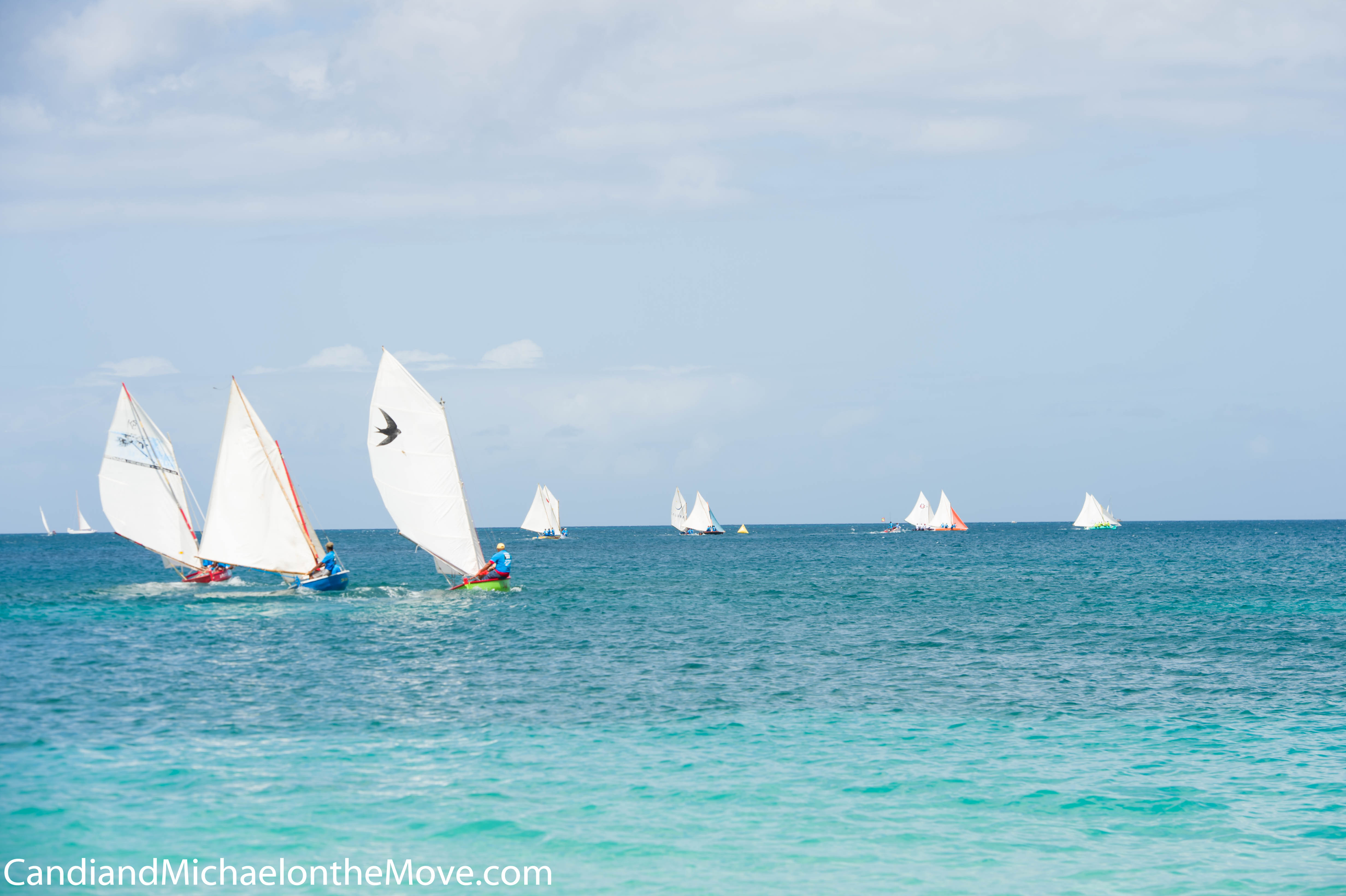
A “picture perfect”, beautiful day for sailing – glorious sun, good wind and definitely a party atmosphere on the beach as visitors and locals root for their favorite boats.

Crystal clear, turquoise blue water lapping onto 2+ miles of white sand beach, makeshift food stalls with mouth watering smells, vendors selling luscious local food and drinks, other stalls selling souvenirs and local crafts, music blaring from a large sound stage, lots of locals and tourists mingling and laughing while about 40 workboats rest on the sand and get prepped for the intense competition to determine which sailing village will hold the honor of winning the 2016 Sailing Festival ~ known locally as the Workboat Regatta.
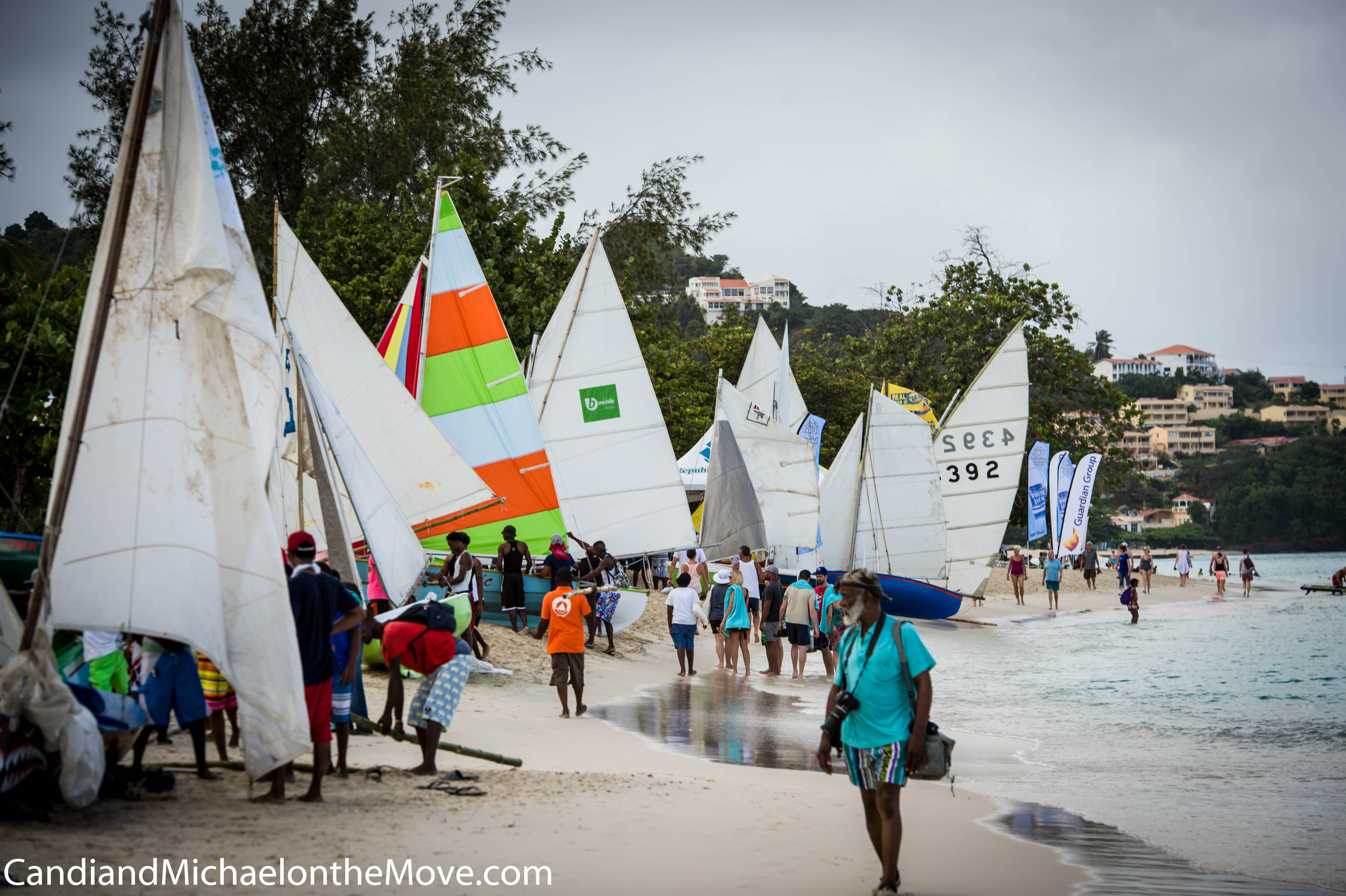
The work boats are rigged and line the beach waiting to be called for their village race. there is tremendous competition between the fishing villages for the distinction of Champion of Champions.
The work boats are rigged and line the beach, waiting to be called for their village race. There is tremendous competition between the fishing villages for the distinction of 2016 Champion of Champions.

The Grenada Sailing Week is bigger than this and is actually a week-long event that attracts sailors from all over the world to race against each other in a variety of races and boat classes, each day ending with a party.  There are 5 classes of yachts that race and each yacht races multiple times.  Results of each race are tallied up to determine the overall winners.  Of course, there is plenty of fun, food and partying going on during the races and at the evening parties.  It’s thrilling to see these sleek, expensive yachts slicing through the waves but, I have to admit, my heart is with the workboats.
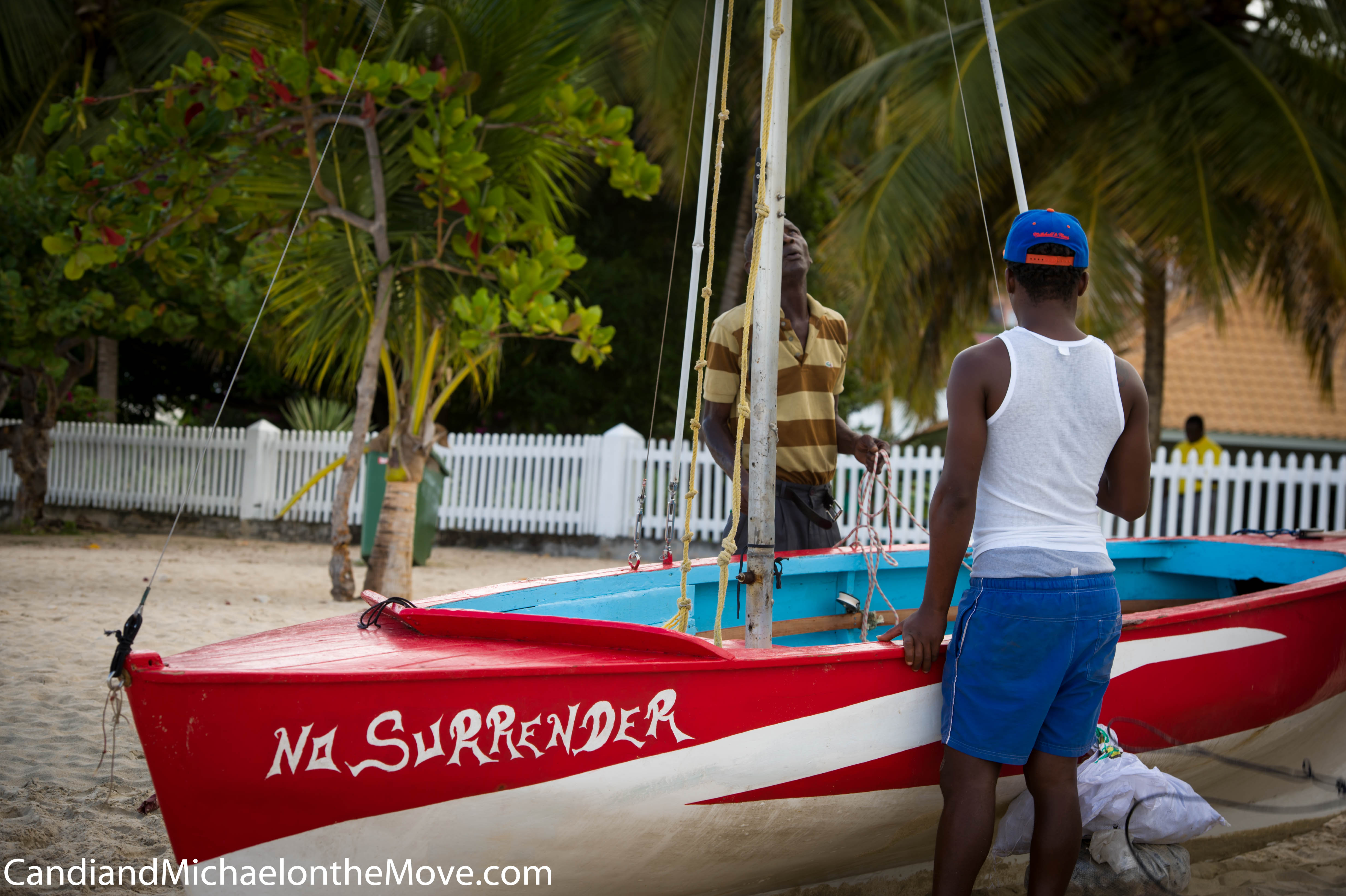
These work boats are owned by the local fishermen and they go out daily to catch "the fish of the day" for the stores, restaurants, lucky residents and savvy visitors.
These work boats are owned by the local fishermen and they go out daily to catch “the fish of the day”. Quite different than the huge commercial ships that ply the oceans. I love the creative names lovingly painted on each boat. (The other side says No Retreat”)

Workboats are the traditional 16 to 17 foot wooden boats that the local fishermen use on a daily basis to bring in the “catch of the day” to restaurants, stores, lucky residents and savvy visitors.  They are powered by motors and do not have sails.  Certain seaside villages in Grenada – Gouyave, Woburn, Grand Mal and Sauteurs are well known for their fishing culture and there is a friendly, but rigorous, rivalry between them each year to claim the prize of fastest boat and best sailors.  The races also attract fishermen from Carriacou and Petit Martinique, Grenada’s sister islands, and sailors from the Grenadine Islands like Bequia and Mayreau.  For the day of the races, bamboo masts are cut and rigged onto the boats in a wide variety of ways ~ almost always including a least some duct tape!
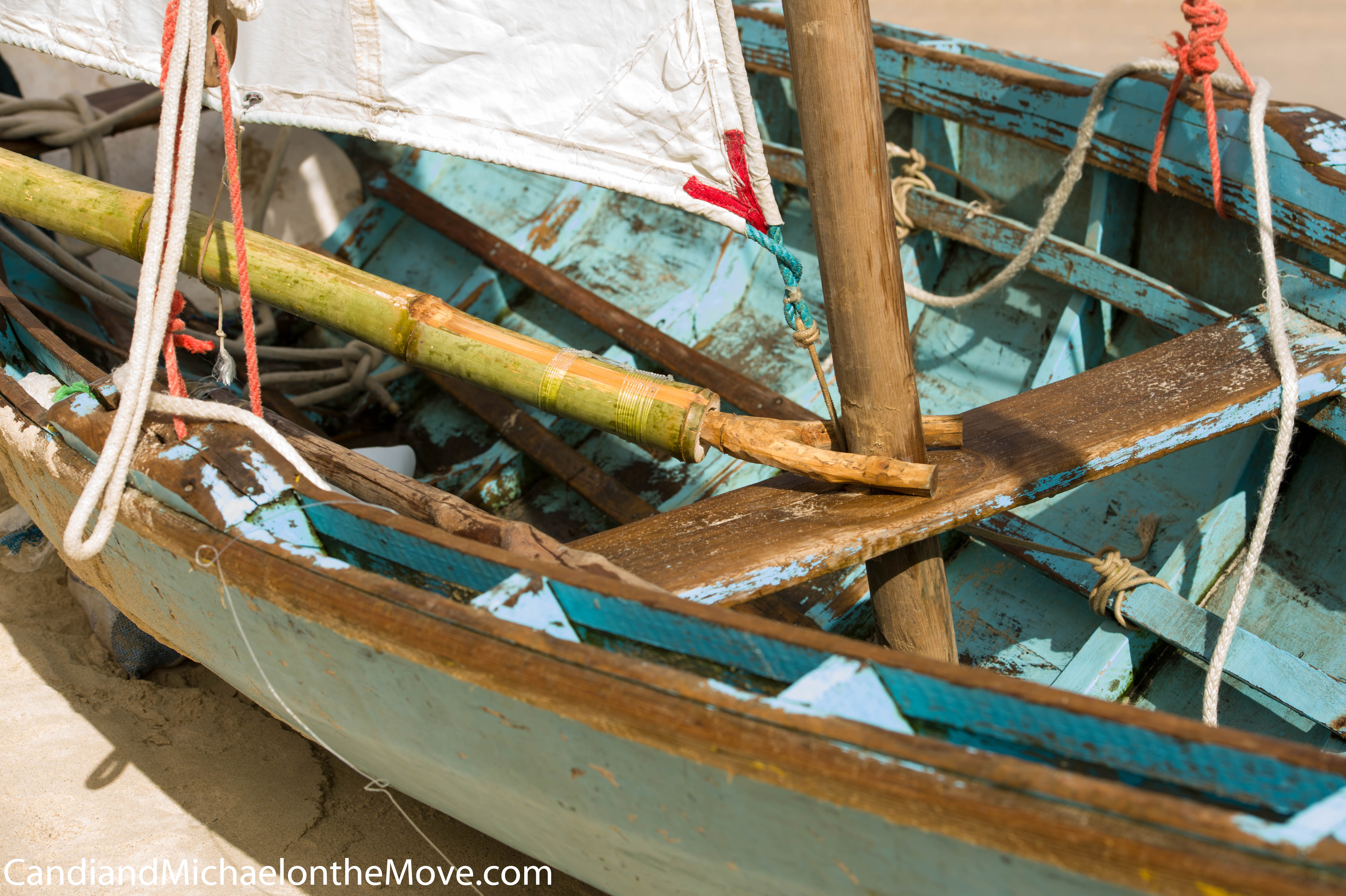
This is a great shot showing the condition of the average work boat and their makeshift masts. This is a very typical set up with bamboo booms.
This is a great shot showing the condition of the average work boat and their makeshift masts jury rigged for sailing in this annual race. This is a very typical set up with bamboo booms.

We’ve been coming to the Workboat races for many years and the boats and rigging have gotten much more professional and now specialty boats are being built specifically for the final race of the regatta with traditional masts and bigger, better sails.  In the early days, more than half the fun was watching the sailors collaborate (argue) and try to figure out how to jury rig their boats with the bamboo masts and sails and get them to stay upright.  Now, it’s more organized and some of the charm and the adventure of rigging the boats from scratch is gone.  But the rivalry, excitement, laughing and fun is still there in full measure.  It is a great 2 day event.  Plus, now we know local fishermen and root for specific boats, as they race each other for the final trophies.
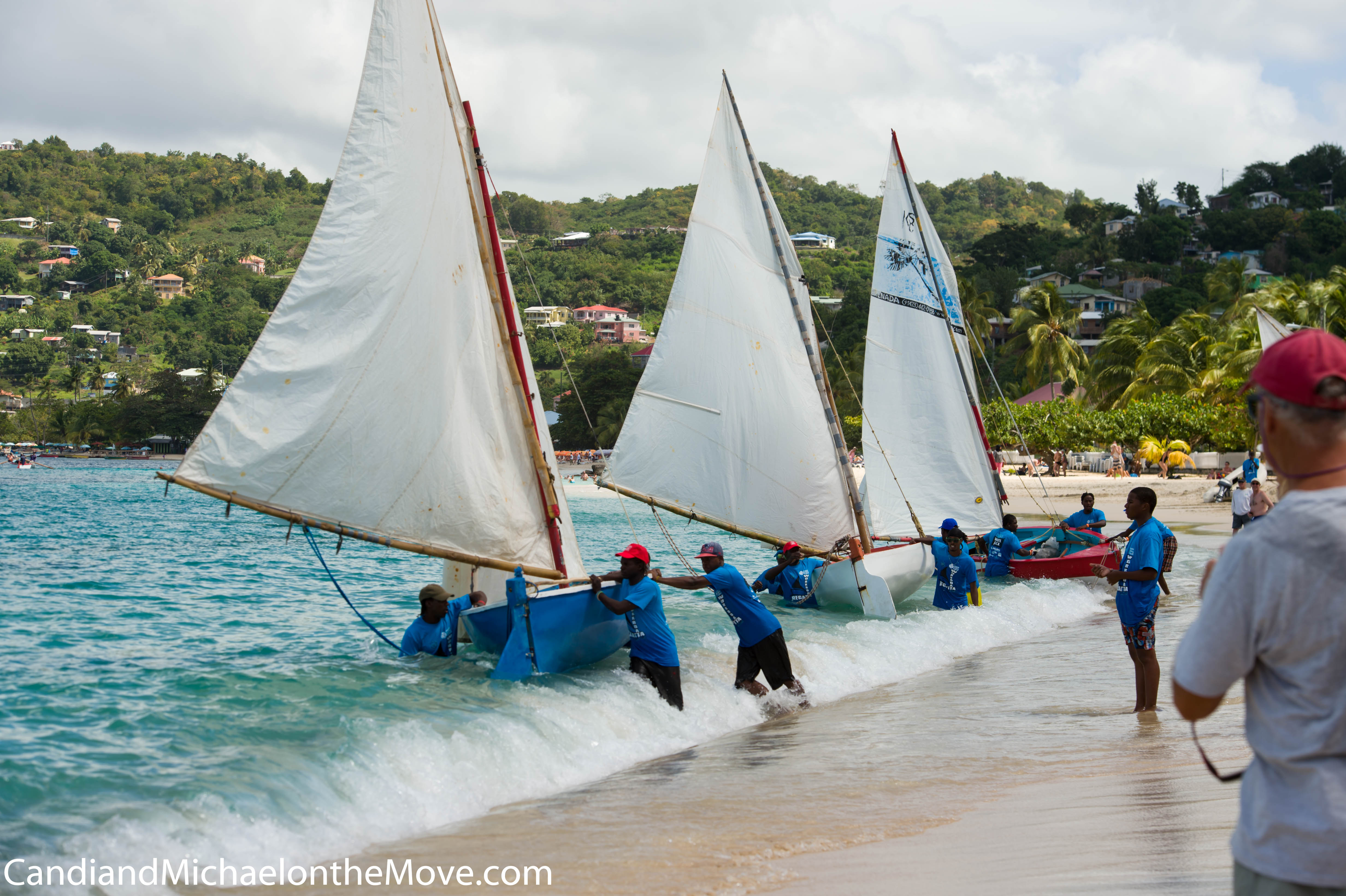
Here, sailors are prepping to sail against each other in acommunity (or village) competition. Thye have pulled and pushed their boats into the surf and are trying to hold them in place until the horn blares, starting the race. Once they hear it, they run pushing their boats into the waves, jumping in at the lasdt minute. The last guy will be almost neck deep in the water when he needs to pull himself up and in.
Here, sailors all from the same village are prepping to sail against each other in a community competition to determine the team that will represent the village in the cross community competition. They have pulled and pushed their boats into the surf and are trying to hold them in place until the horn blares, starting the race. Once they hear it, they push their boats into the waves and jump in at the last minute. The last guy will be almost neck deep in the water when he needs to pull himself up, over and in. Often there are legs flailing!

Our local fisherman, Captain Ray, had one of the boats racing for Woburn.  We get the bulk of our fish and Lobster from Captain Ray.  He doesn’t carry a phone so Michael or I need to head over to the Woburn dock around 3 o’clock to see what he has caught that day.  My favorite is Lobster which is $12XCD or $4US per pound.  He has also turned us on to wonderful crab and, on any day, may have 2-3 types of regular fish to sell, as well as lambi (or conch).
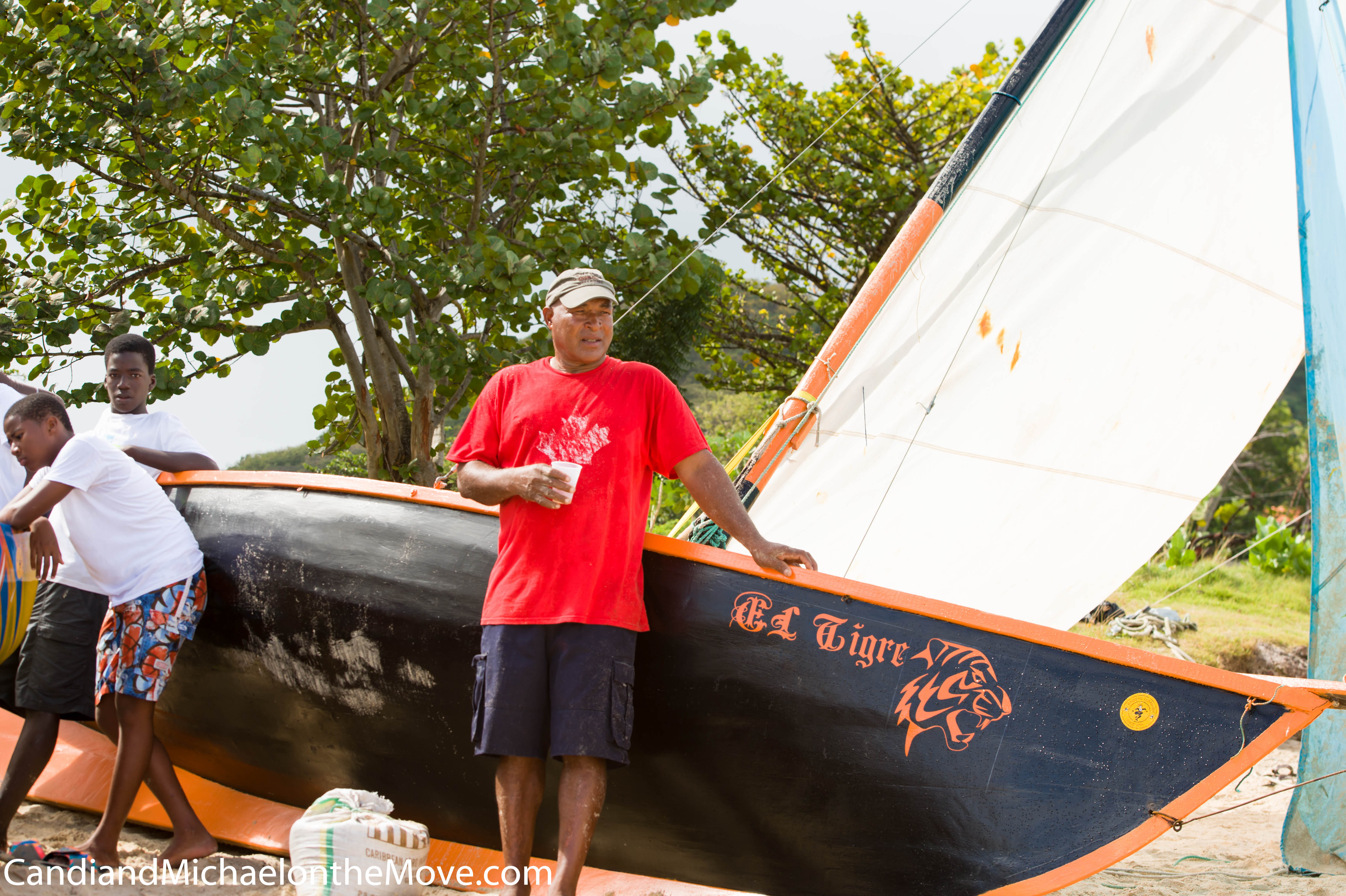

Captain Ray, leaning against his workboat, waiting for the village of Woburn to be called. Unfortunately, the Tigre will not place in the finals this year.
Captain Ray, leaning against his workboat and enjoying a rum, waiting for the village of Woburn to be called. Unfortunately, E L Tigre did not place in the finals this year.
Look at the size of this starfish!

We stayed for most of the day on Saturday to watch the races, eat the great Grenadian food and soak up some sun.  The food booths all looked great but one booth stood out.  Everything there looked fantastic and we got grilled fish, jerk chicken and oil down, Grenada’s national dish.  The food was so good, I went back to meet and compliment the chef, Rain.  I found out that she serves food at a Vendor night on Wednesdays at True Blue Bay Resort  and now we are regulars to her booth each week.  YUM!  A bonus was seeing a number of HUGE starfish when we were swimming, between races.

On Sunday, the winning workboat and village is announced.  Then there is an additional race where the specialty boats race.  Each boat is the same and each town nominates a composite, “winning” crew from all their sailors to battle it out for the best sailing team of the weekend.  We didn’t attend on Sunday this year and it’s been a trial trying to figure out who won the final trophy, Champion of Champions.  There was a lot of local press coverage leading up to the race but NOTHING after to say who won.  I checked the Sailing Festival website which again was updated almost daily until the start of the races and then …. nothing!  I checked with Captain Ray but he wasn’t sure either.  Three WEEKS later, feeling frustrated, I started scouring the internet and, way down in the search results, I found a FaceBook page for the Sailing Festival with all the results ~ Success!  Facebook, the great equalizer and disrupter of the tried and true news sources.  (I am now following this page).
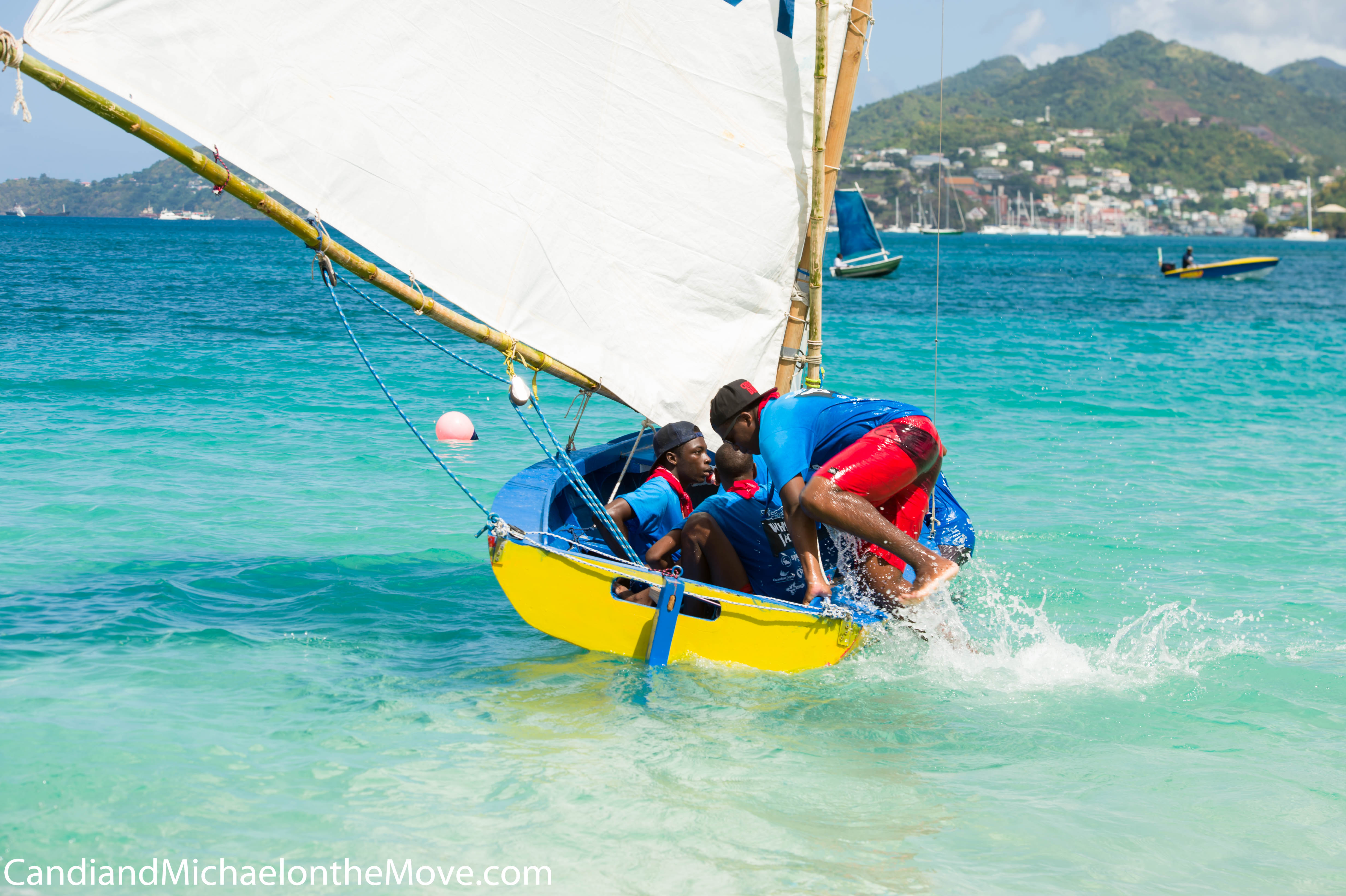
Last man jumping and diving into the boat as it takes off from shore.
Last man jumping into the boat as it takes off from shore.

Here are the final results.  (The list is long but I included the entire list because the names of the boats are as colorful as the paint jobs and I thought you would enjoy them):

Community Class Races – These are the top 3 winners from each village (or island).

Carriacou

  1. Ark Royal — Skipper Vernell Phillips (Boat from Bequia)
  2. Lightning — Skipper Adolphus Forde (Boat from Mayreau)
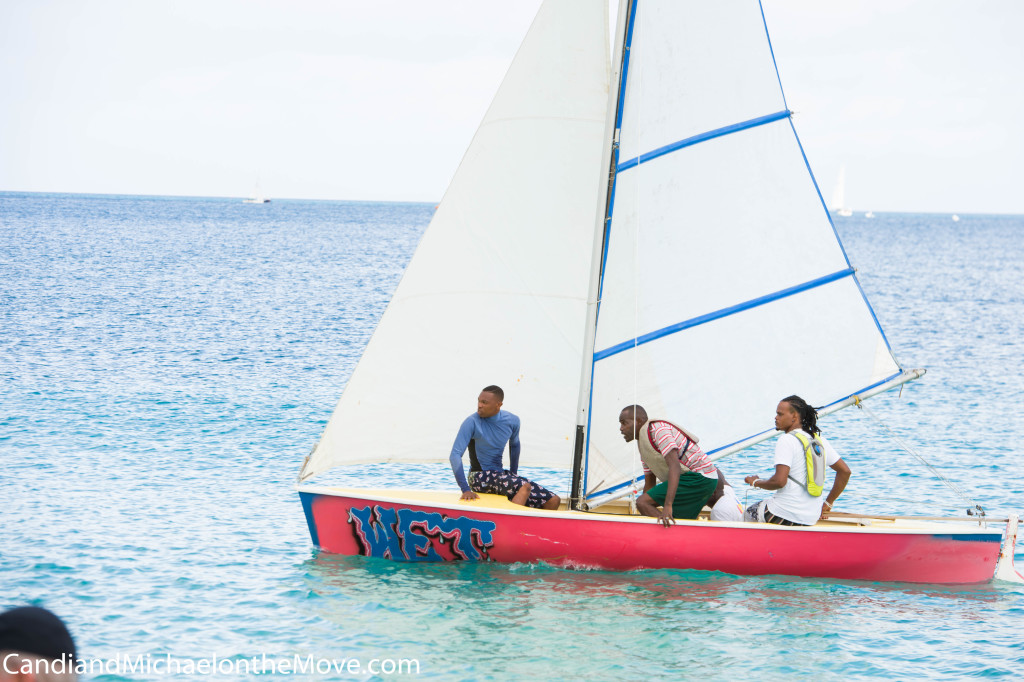
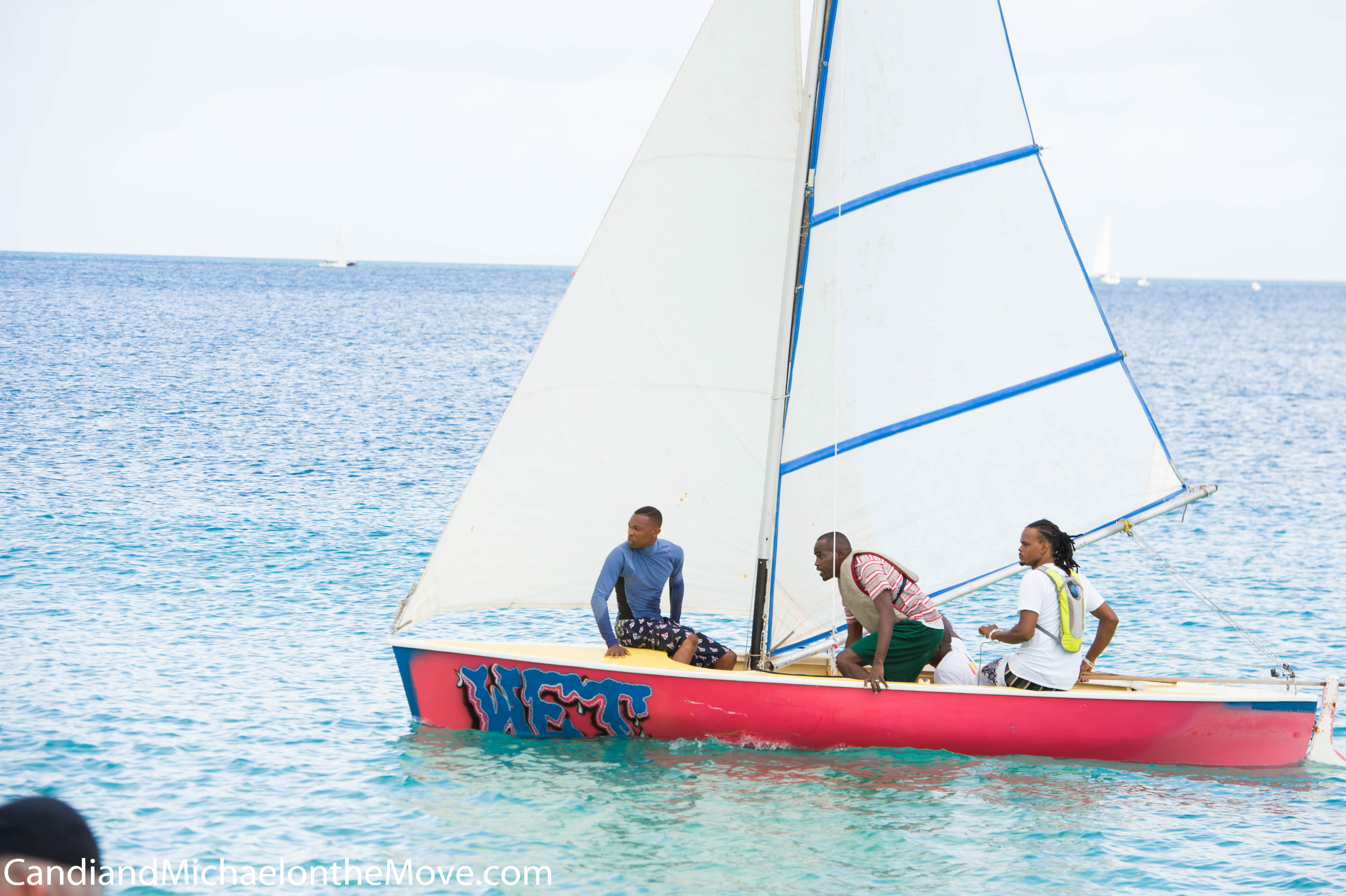
  3. Wet — Skipper Carl Edoe

    "Wet"
    “Wet” off to a good start.

Gouyave Canoe

  1. Sonic — Skipper Israel Darangit
  2. Etieron – Skipper Carlyle Joseph
  3. Sky Red — Skipper John George

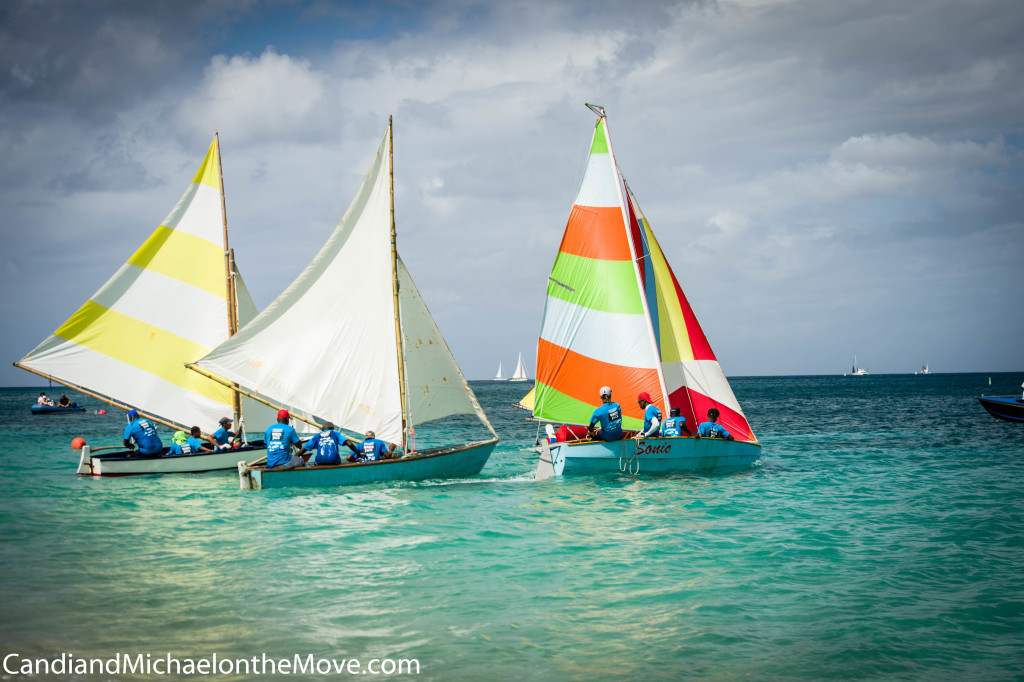
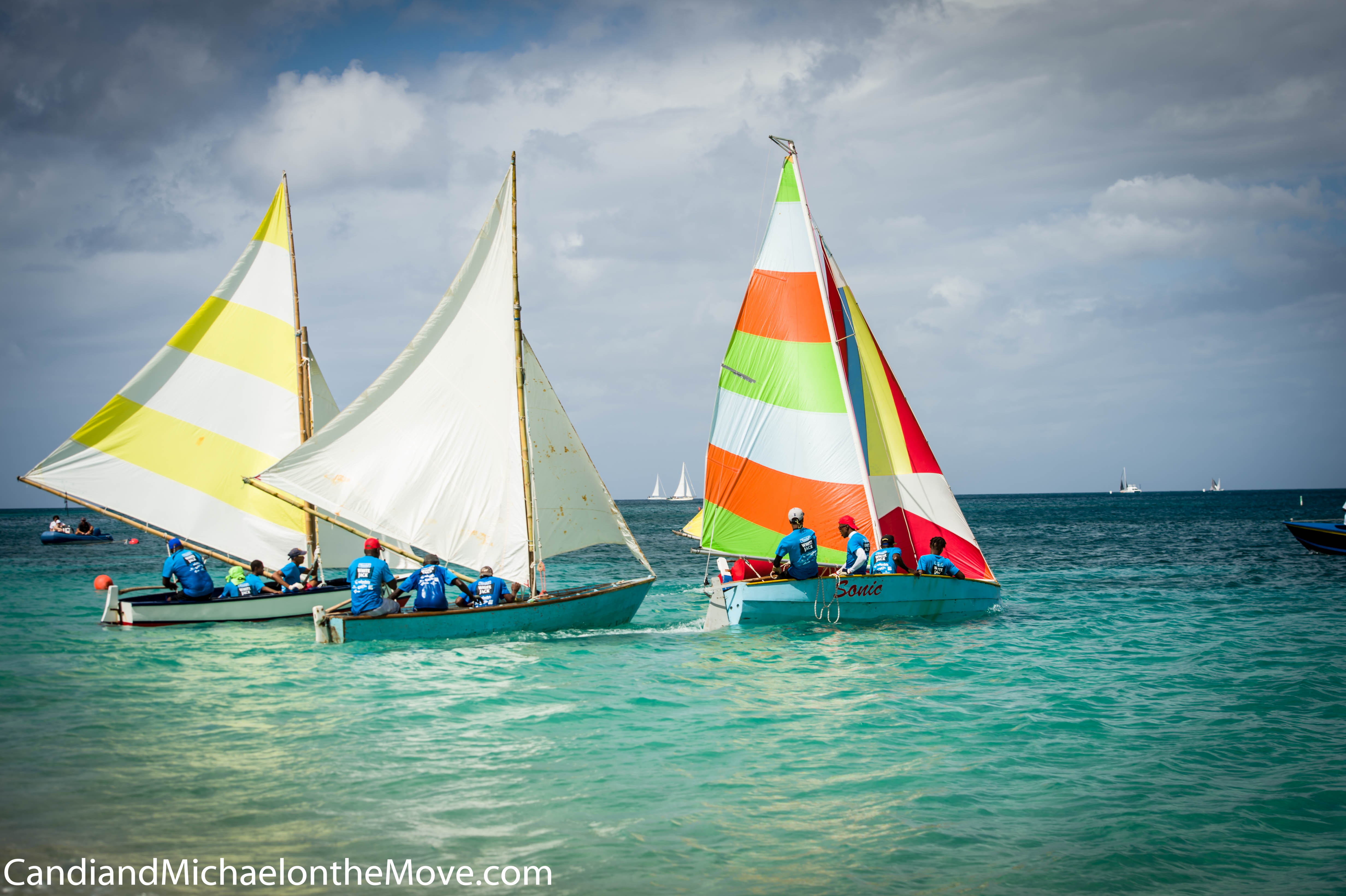
    "Sonic" leading the pack.
    “Sonic” leading the pack.

Gouyave Sloop

  1. Reborn – Skipper Kwesi Paul
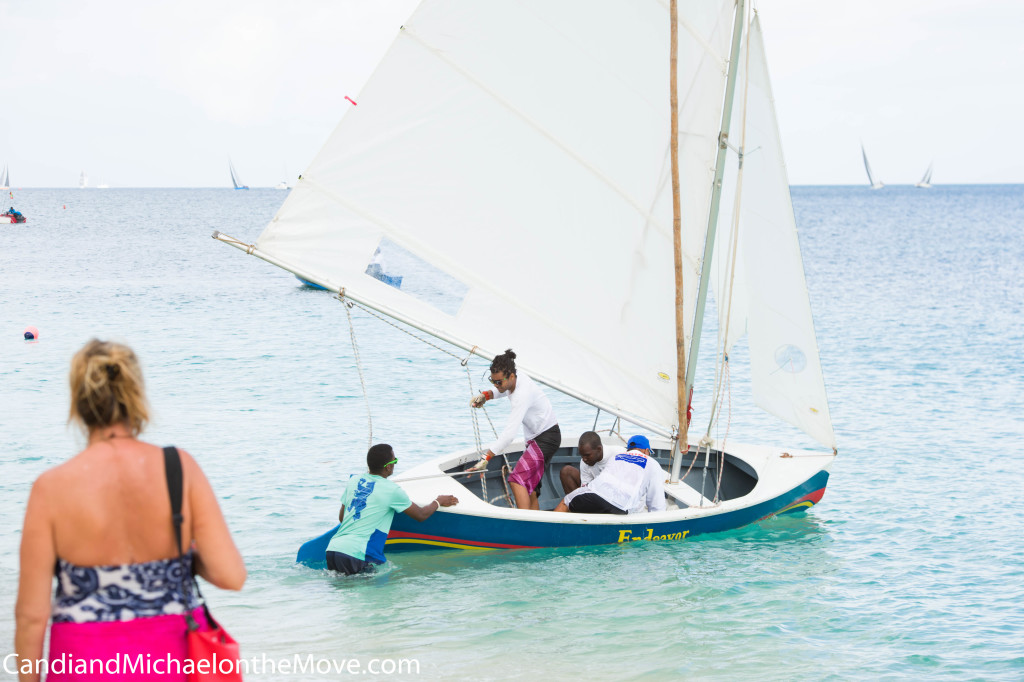
  2. Endeavour — Skipper Javid George
  3. Classic — Skipper Ted Richards

    "Endeavor" rushing off the start line.
    “Endeavor” rushing off the start line.
Sauteurs

  1. Swift — Skipper Christopher Jaheir (Boat from Grand Mal)
  2. No Retreat No Surrender – Skipper Bertrand Noel
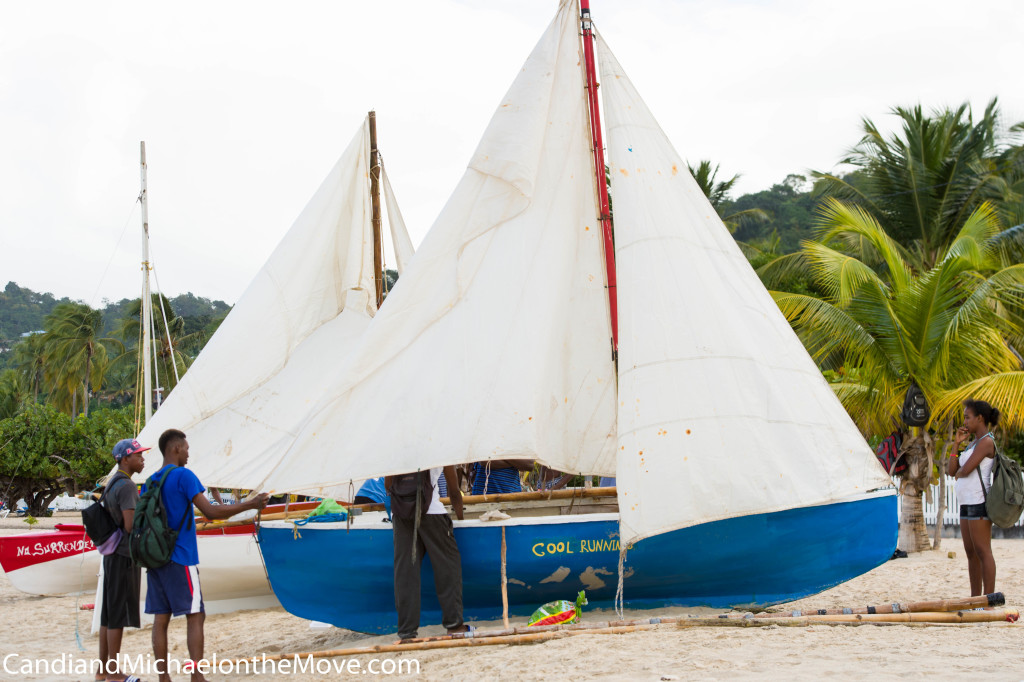
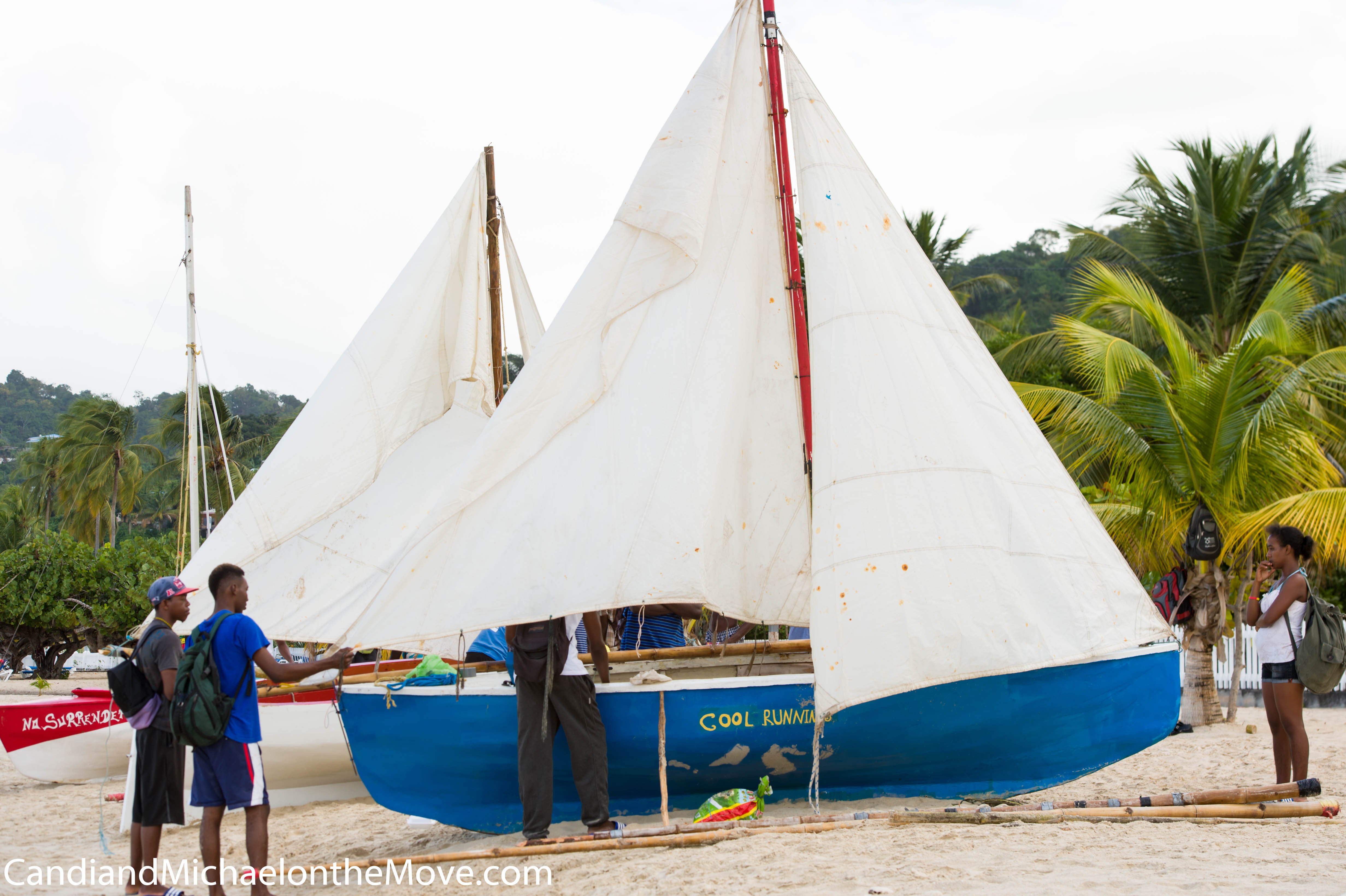
  3. Cool Runnings — Skipper Ryan Olive

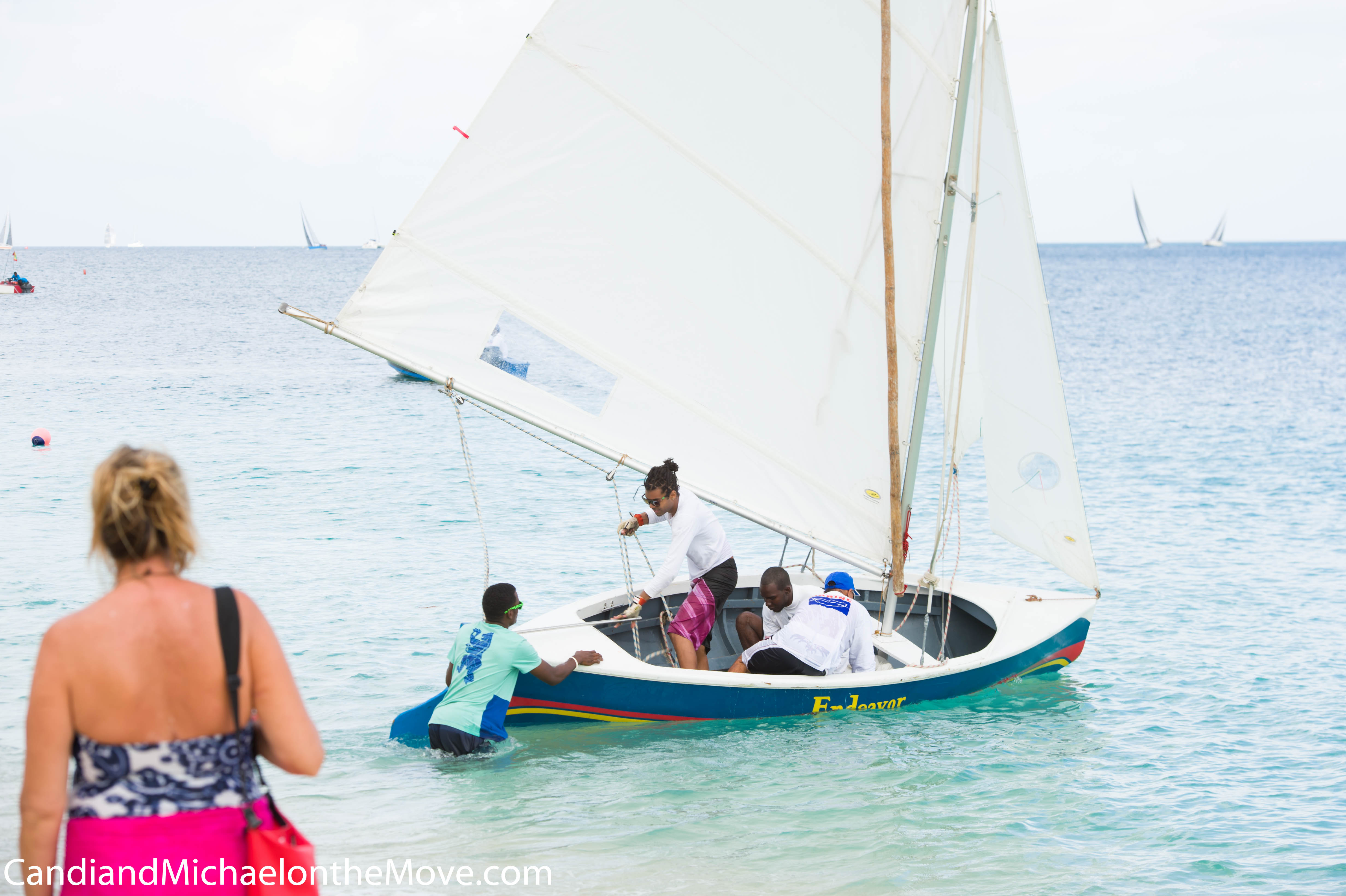
    "Cool Running" getting rigged for its first race.
    “Cool Running” getting rigged for its first race with “No Retreat, No Surrender” in the background.
Woburn

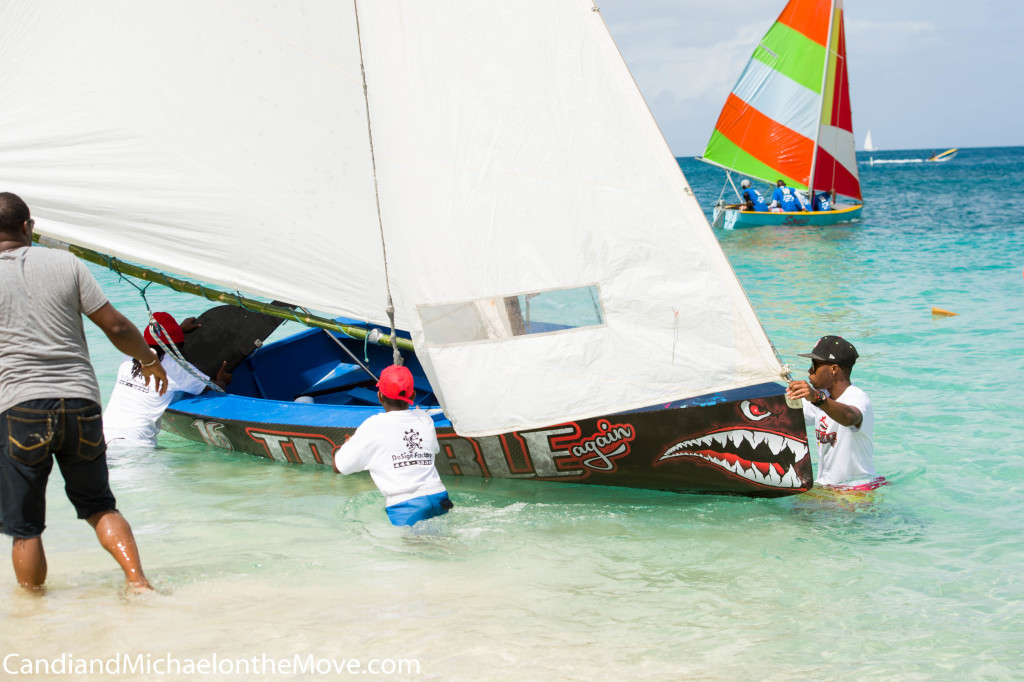
  1. Trouble Again — Skipper Allan Noel
  2. LOCAL – Skipper Clinton Brathwaite
  3. Press Play — Skipper Shakeil Gibbs
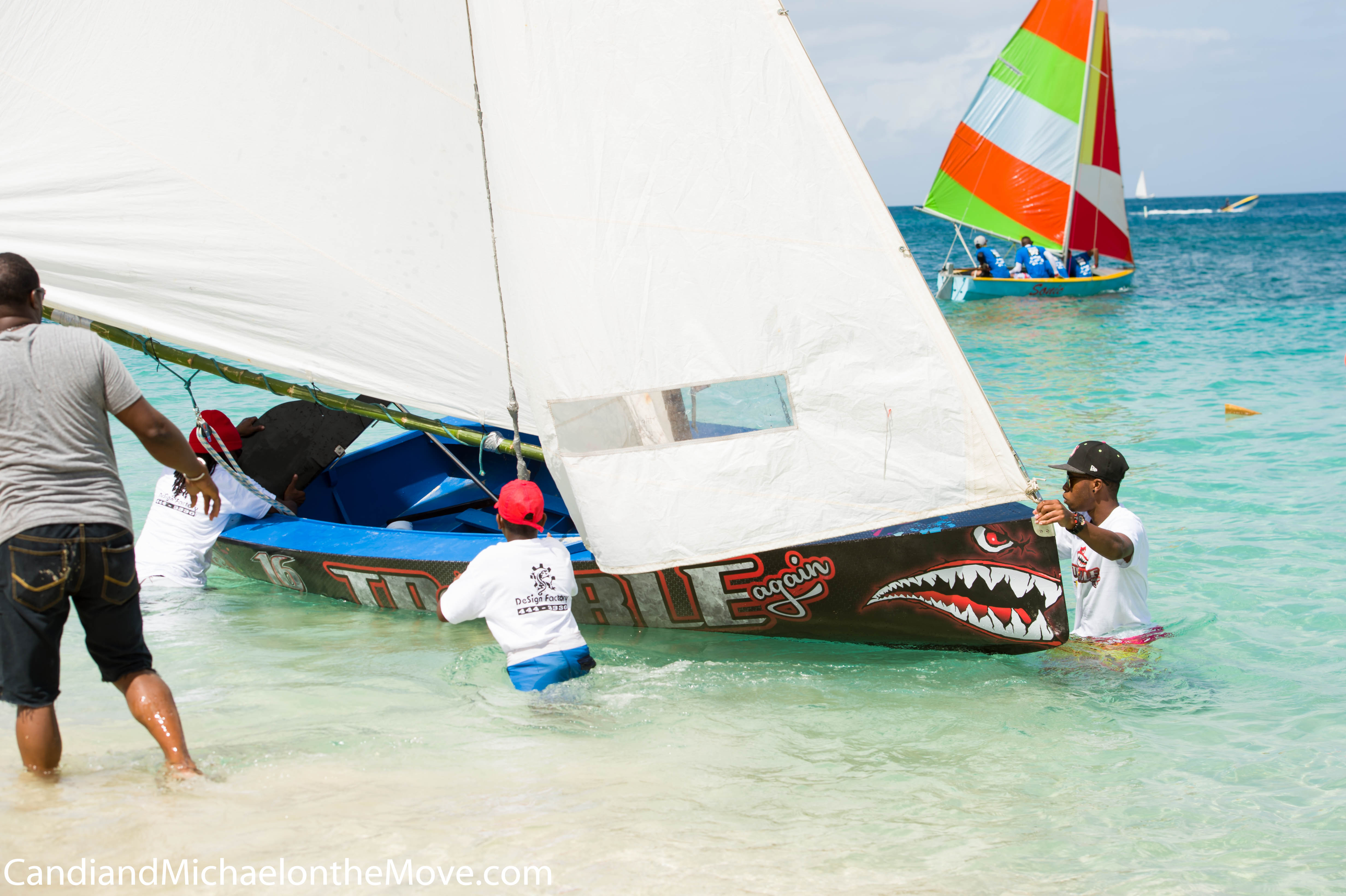
    "Trouble Again" won the Woburn race.
    “Trouble Again” won the Woburn race. I love the graphic on the bow – no messing with these guys!
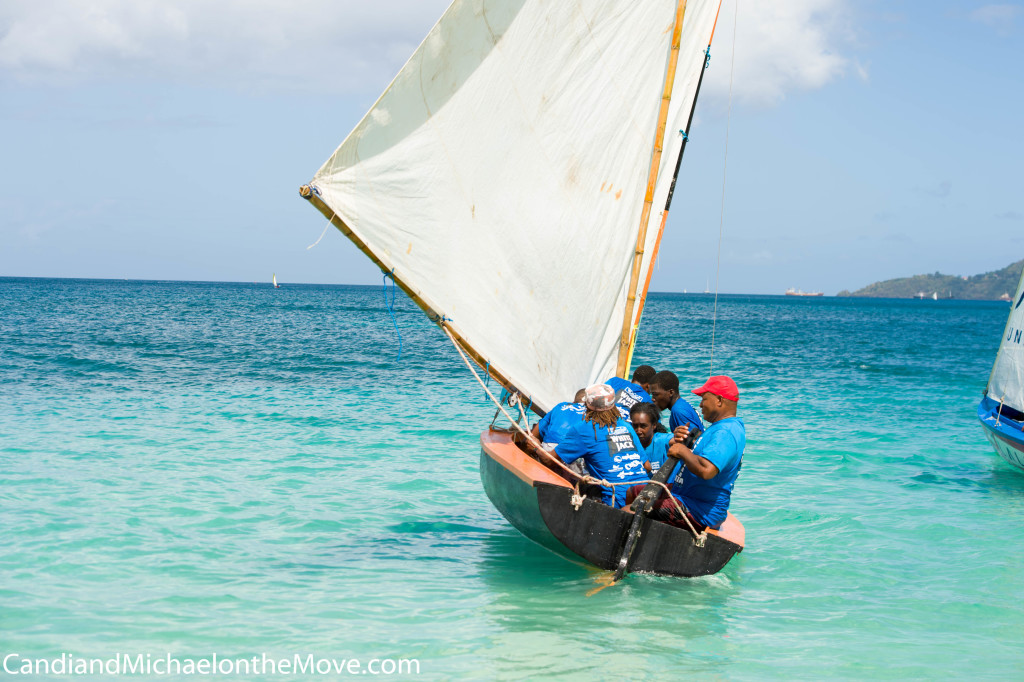
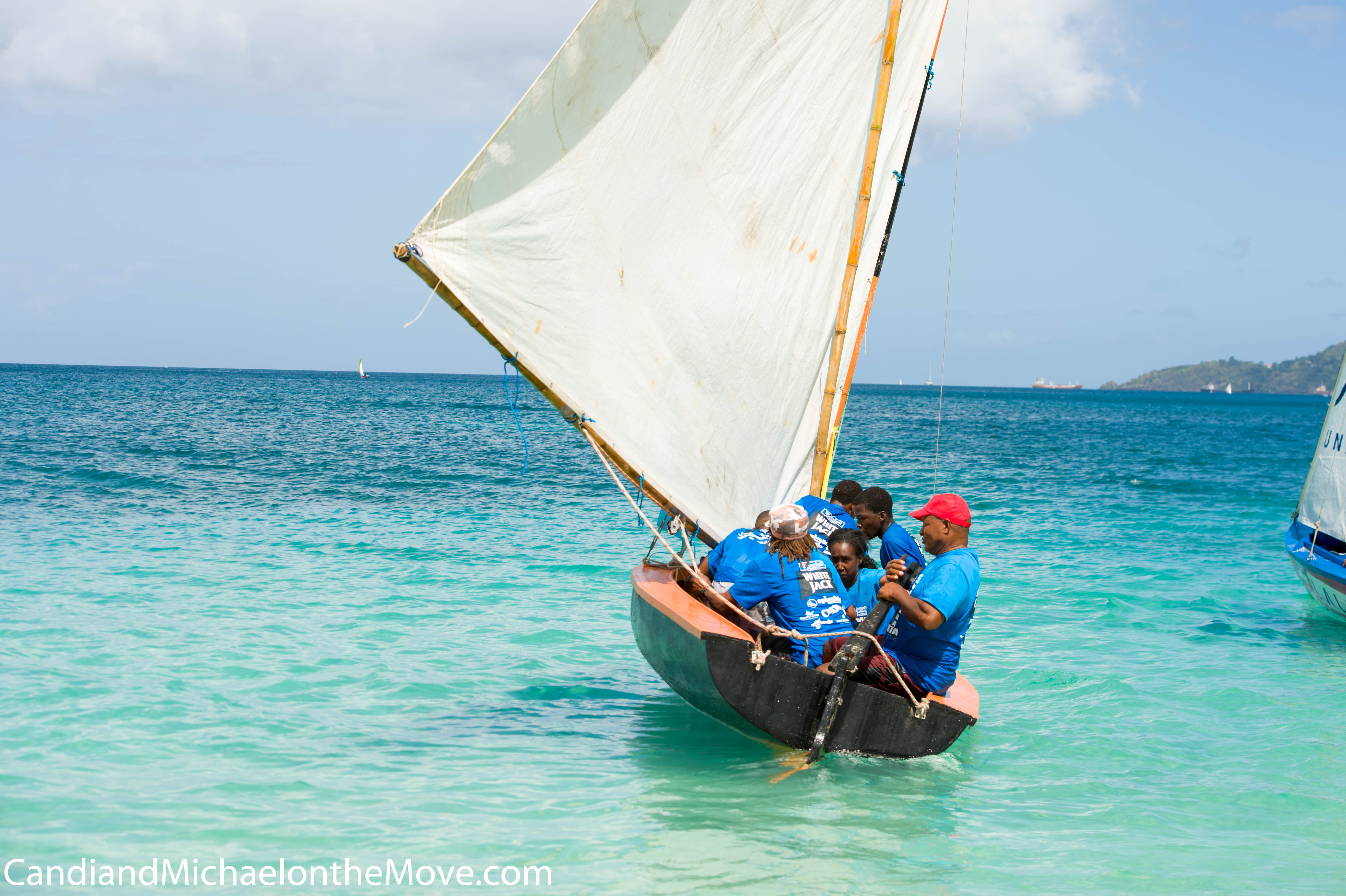
    Captain Ray's boat, Tigre, off to a good start.
    Just starting to heel and “looking fine”. If you think this is an overloaded boat, I assure you it is not. One holiday, we were invited to a barbeque on a popular island off shore and this size boat was so full it was only floating about 1 inch out of the water ~ and people were still kept getting on! I figured, worst case we’d sink and it was a short swim in warm water to get to the island. We arrived safe and sound, just like the locals said we would ~ AMAZING!
Match Race Finals – This is where each village picked their best sailors from all their boats and raced all using the same type of boat to showcase the best team of sailors.  There are 2 classes Junior and Senior:

National Team Sailing – Junior – Sponsored by Budget Marine
1. Team Woburn – sailing in Gybe Talk
2. Team Gouyave – sailing Mr.X

National Team Sailing – Senior – Sponsored by Carib
1. Team Sauteurs –- sailing in Tomorrow’s Worry
2. Team Gouyave –- sailing in Mr.X
3. Team Woburn – sailing in Gybe Talk
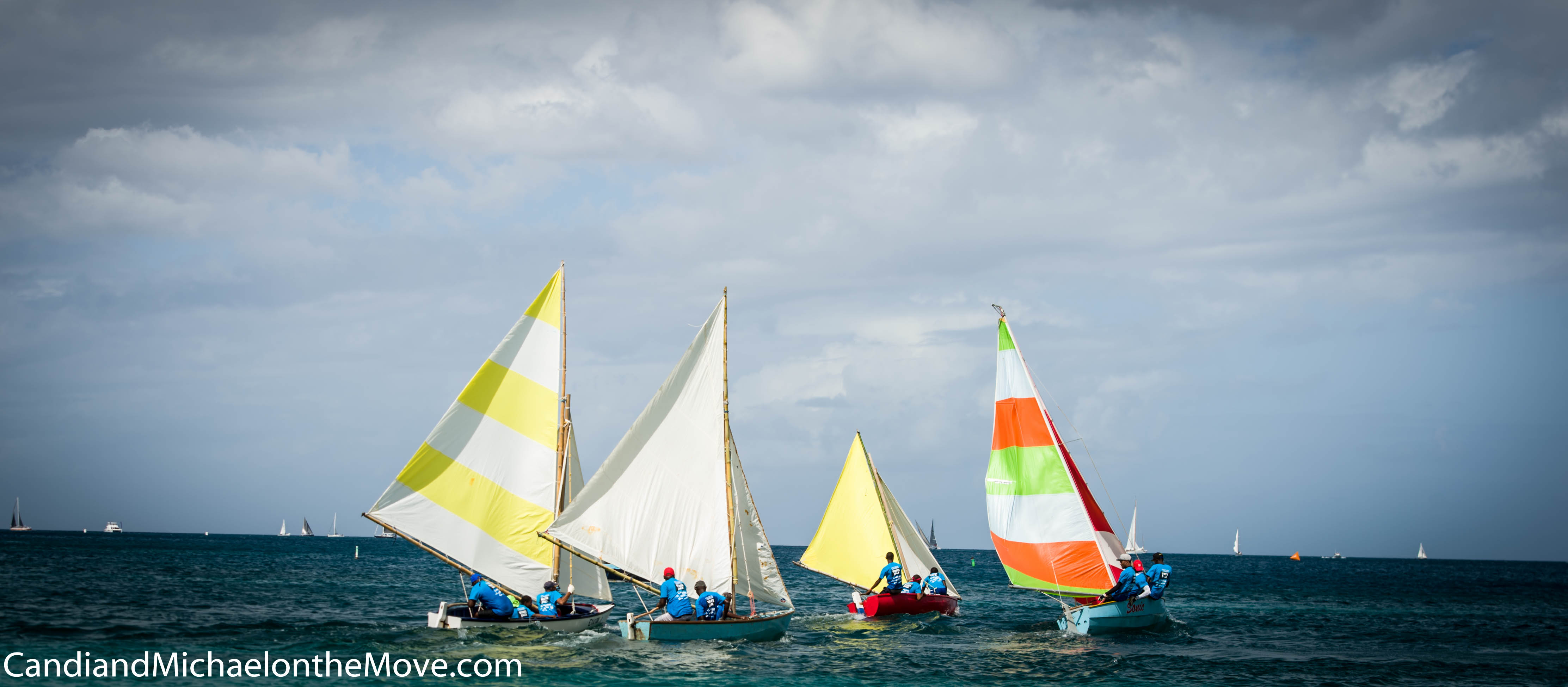
A fast start to one of the Village races. It's a miracle they don't all collide as they fight for position.
A fast start to the village of Gouyave race. It’s a miracle they don’t all collide as they fight for the lead position.

‘Champion of Champions’ Match Race Final –  The Skipper & crew from the winning boat in each of the Community Class races, using the same type of boat  to determine the ‘Champion of Champions’

Grand Winner for the 2016 Champion of Champions:
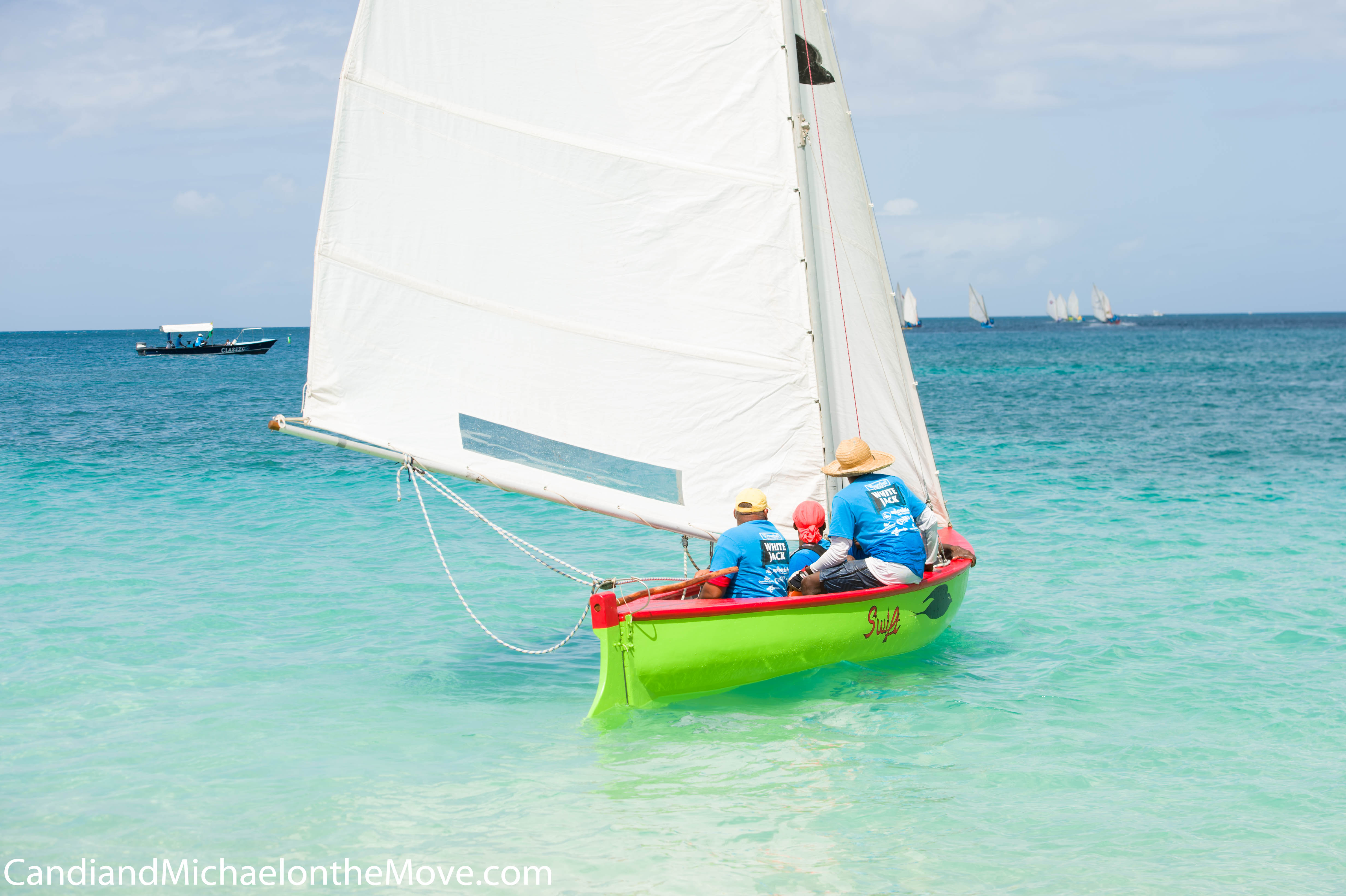
"Swift" the winning community boat AND the sailing team that won the 2016 Champions of Champions racing all the other winning villages in competition boats.
“Swift” the winning community boat AND the sailing team that won the 2016 Champions of Champions racing all the other winning villages in competition boats.

First Place: Grand Mal — with a crew from the winning boat Swift — Skipper Christopher Jaheir.  Imagine his pride being named the best of the best and winning US$1,000 and a Yamaha outboard motor from McIntyre Brothers  This is quite the prize ~ You’ve seen these boats.  The cost of a brand new motor is way out of most Captain’s means and  $3000XCD is over a month’s wages for a well paid earner. (Compare it to a person in the US making $48K a year and winning $5K and getting a new car – a literal windfall.)

Second Place: Gouyave — winning US$500.00
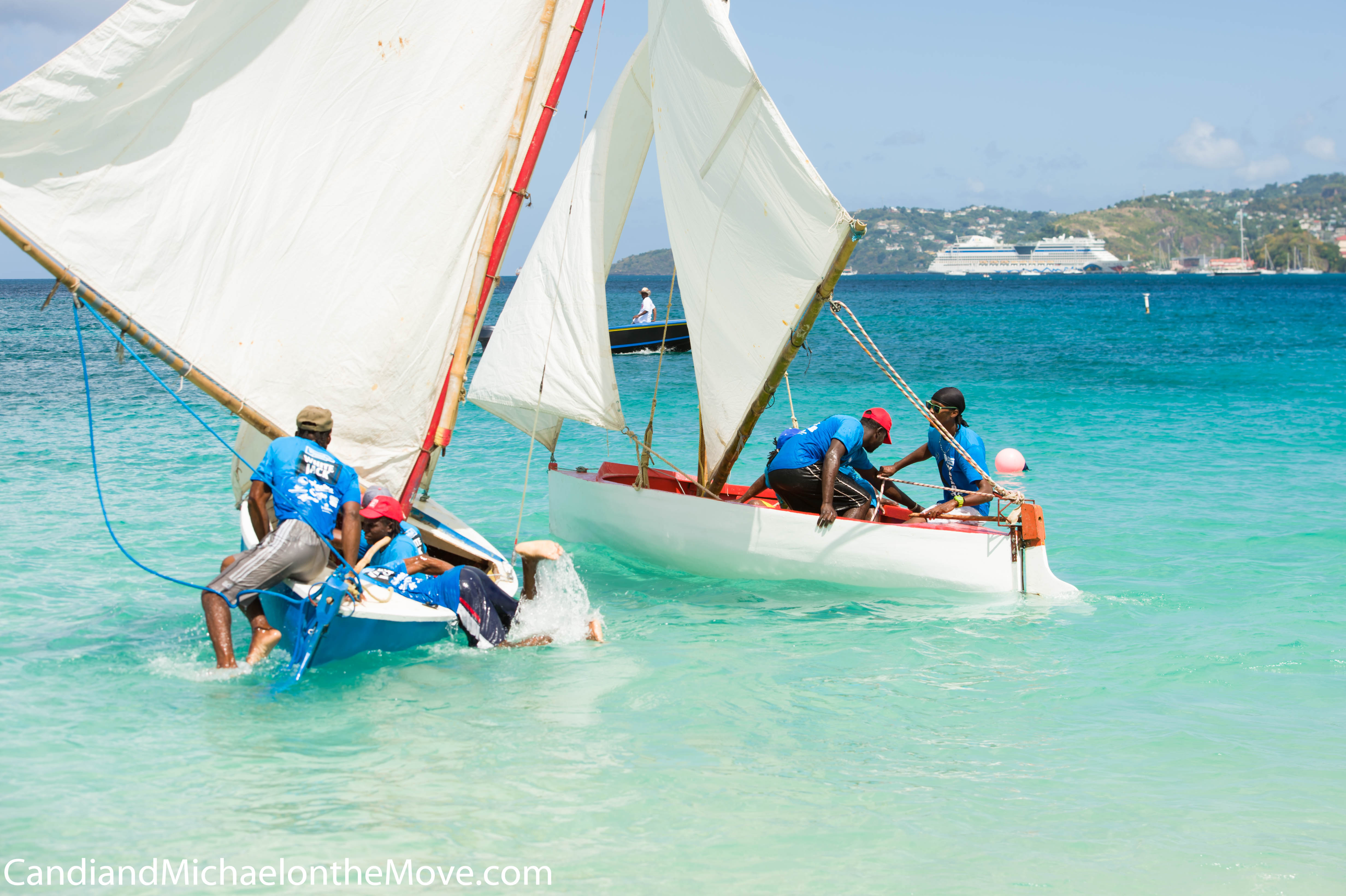
Feet flailing and the last sailor "dives" into the boat.
Notice the guy hanging off the left side of the left boat – trying to keep it from capsizing as, feet flailing, the last sailor “dives” into the boat.

Third Place: Woburn — winning US$250.00
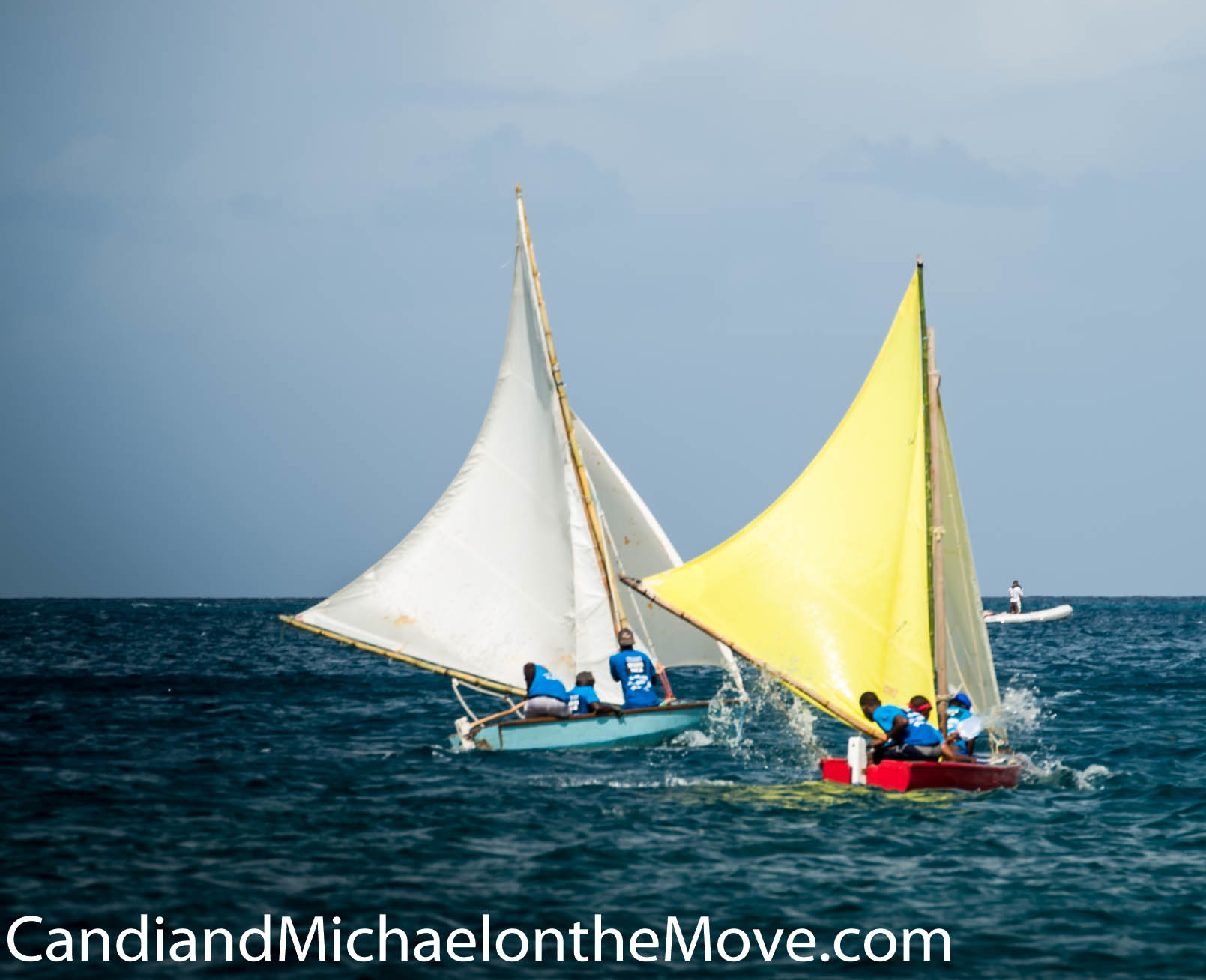
And there is always bailing .....
And there is always bailing …..

All in all, another wonderful Sailing Festival.  I can’t wait until next year.  And hopefully, we will have some friends visiting – Save the date – January 28th and 29th, 2017

BONUS:  Here is a great video of the Sailing Festival that gives a good feel for the event.  Posted on Facebook on the Sailing Festival page, created by True Blue Resort, one of the Festival sponsors …. Grenada Sailing Festival video
Filed Under: Expat life, Grenada, Travel Tagged With: Grenada, Grenada Sailing Festival, sailing, travel

Walking the Plank ~ to Dinner

February 4, 2016 by Candi Licence 1 Comment

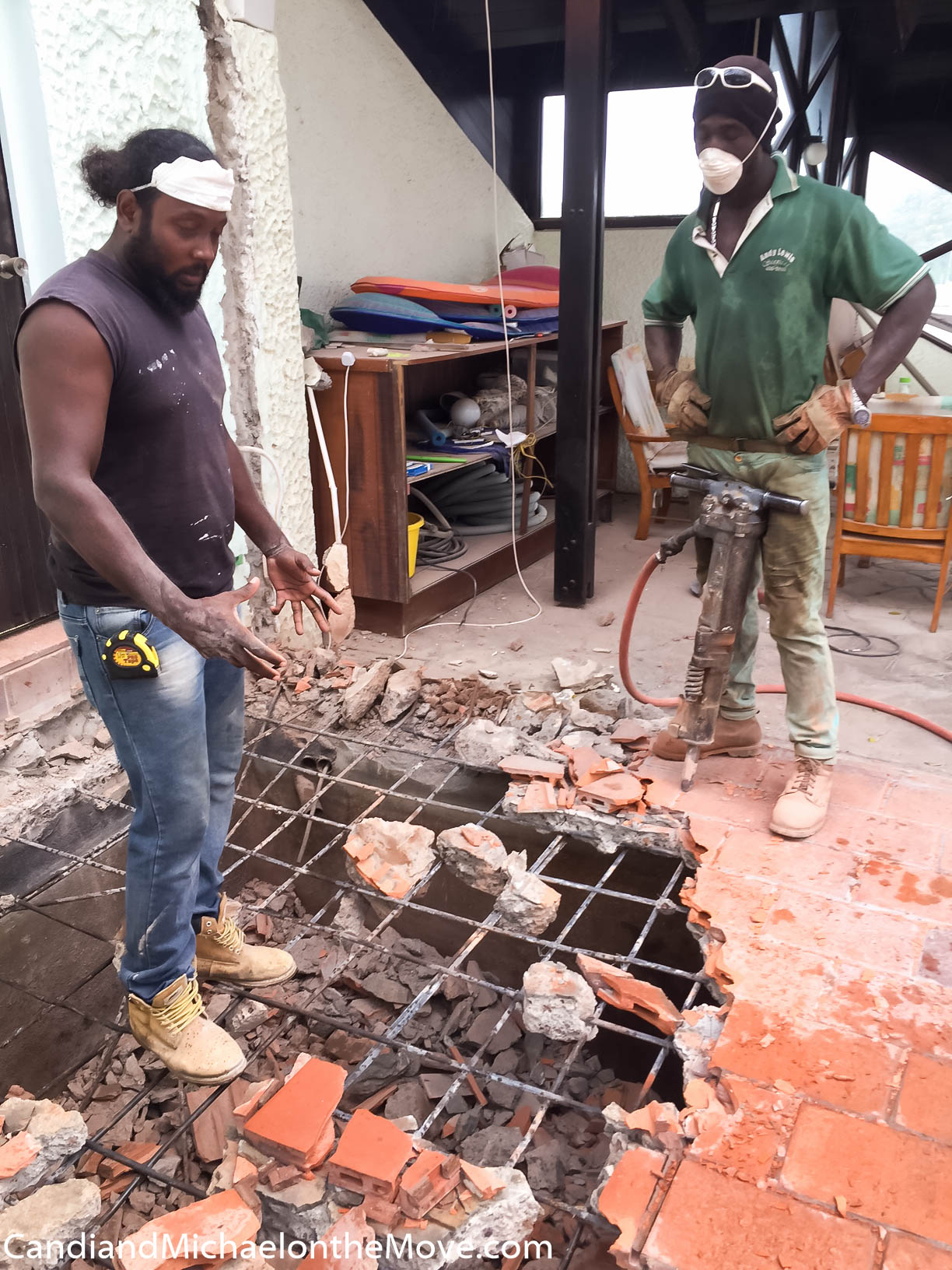
Saturday, January 30th at exactly 8:43 AM the jackhammering began.  We had already planned to be at the beach most of the day to watch the Sailing Festival but the noise and activity was a great impetus to get up and out early.

The start of the jack hammering. Check out the jackahmmer. Can you believe they are walking on top of the rebar? YIKES!
The jack hammering begins bright and early, dropping the rubble into the cistern below. Check out the jack hammer. Can you believe they are walking on top of the rebar? YIKES!

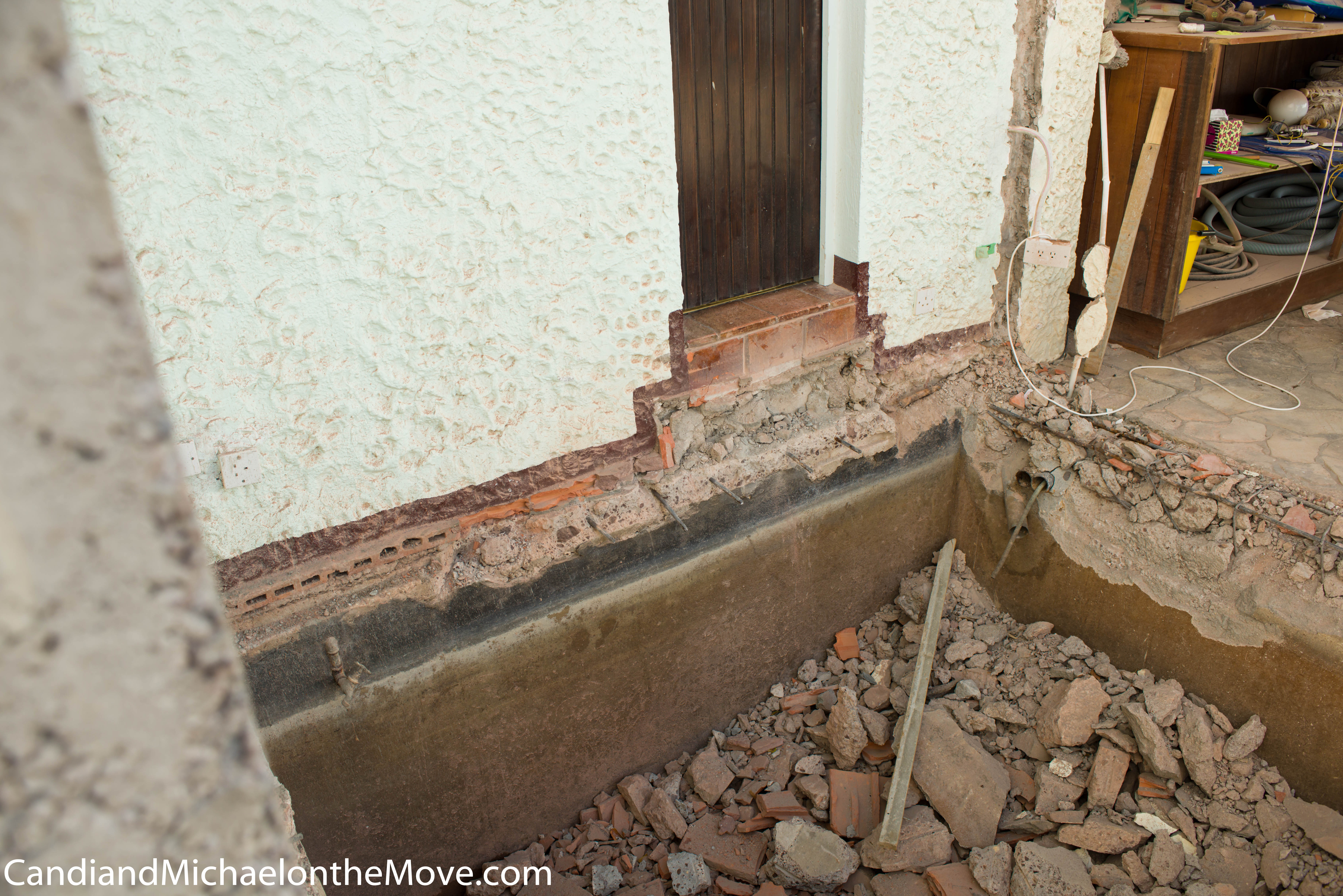
The living room floor is about 8 inches higher than the patio floor so as we move the wall to shorten the living room space, we need to lower the remaining floor to match the patio floor.  The living room floor is tiled and underneath the tile is a water cistern that captures rain off the roof and stores it.  Therefore, we need to jackhammer the tiles free, remove and then replace the “ceiling” of the cistern in order to lay down a new floor.

By removing the floor, we have effectively temporarily cut off access to the second master bedroom, as well as the patio.

As expected, the jack hammering ends up being an all-day process.  There’s thick tile to cut through, heavy cement holding the tile in place, plus a cement floor underneath (or ceiling above, depending on your perspective)  and lots of rebar.  When I left a short while into the demolition, a medium sized hole had been created.  This cut off the access to the second master bedroom and started to cut off access to the patio from the house.

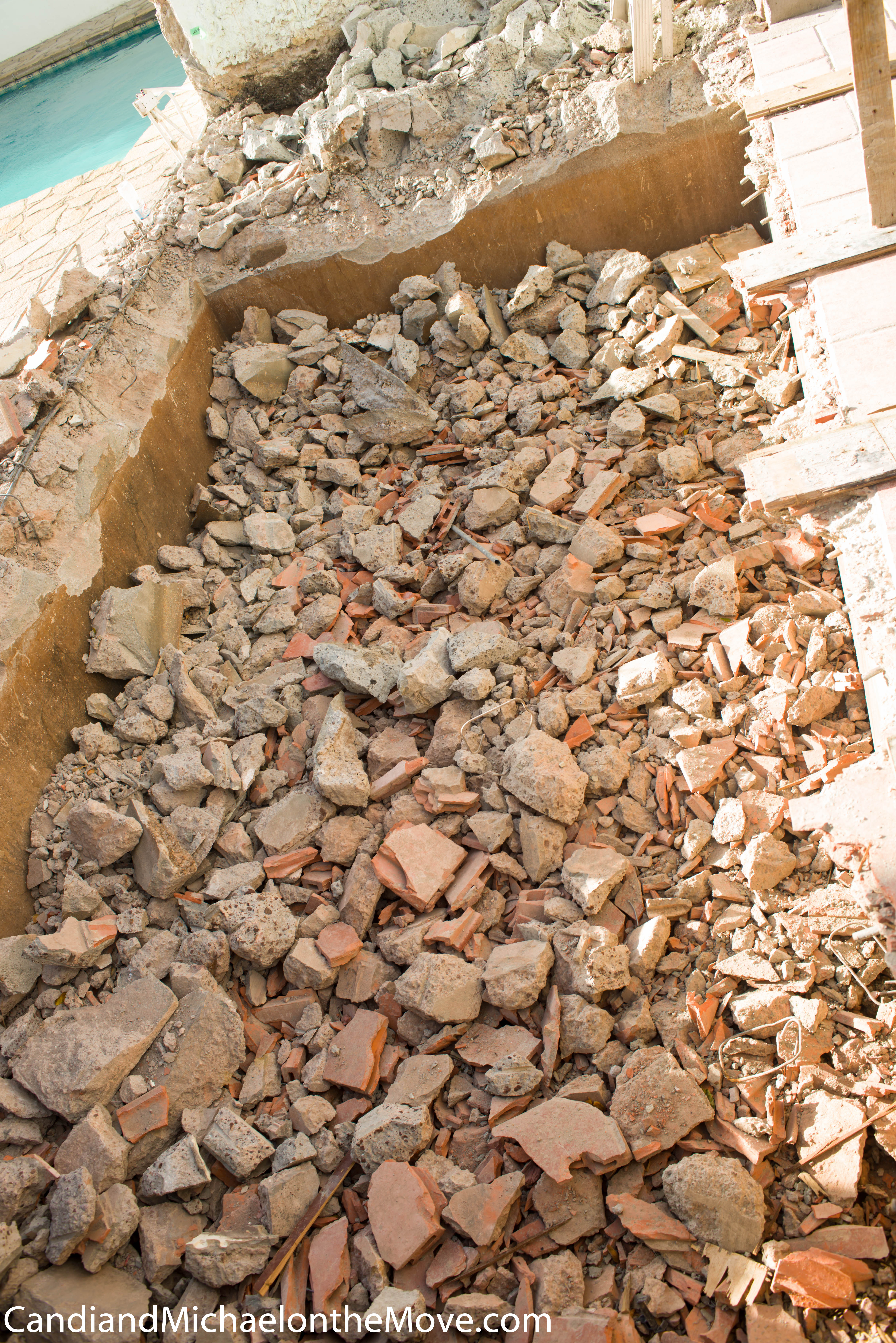
All this rubble which is filling up the cistern needs to be lifted out, wheel barrowed away and then trucked away.
All the floor rubble completely filled up the cistern. It needs to be manually lifted out and then wheel barrowed away.

Since we spend most of our time on the patio, having no access would seriously cramp our lifestyle.  The workers promised to build us a bridge to provide access to the patio while they work on recreating a new floor.

There is a tremendous amount of work that needs to be done to accommodate this “small change” of moving the living room wall.  We expect it will take 2 to 3 days to remove all the rebar and cement rubble that now resides at the bottom of the cistern.  Then they need to put in new rebar that will reinforce the new floor, build a temporary wooden cistern “ceiling” under the rebar so they have a foundation on which to pour a new floor.  The new cement floor will take 21 days to cure.

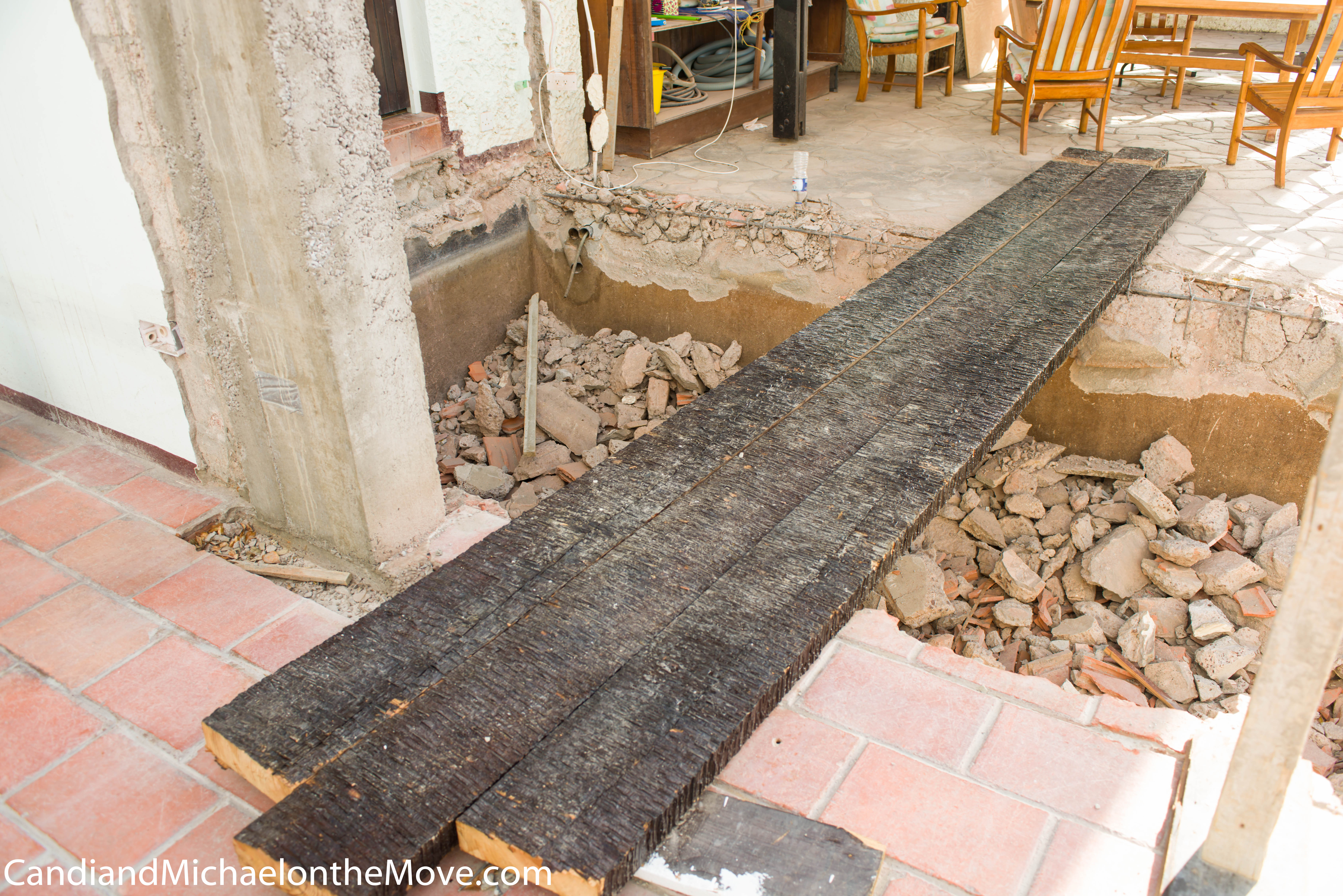
In the meantime, we have a “bridge” to the patio that is made out of the large rafters that were saved when the living room ceiling was removed.  And if this doesn’t feel like I am walking the plank to get to the patio, I don’t know what would.  The rafters are pretty solid, but it is a fairly long opening and remember the two floors are at different heights so there is a fair amount of flexing as I walk the plank.  Doable, but you definitely want to be paying attention because each plank flexes independently!

Our "bridge" from the living room to the patio ~ hence the walk the plank feeling.
Our “bridge” from the living room to the patio ~ hence the “walk the plank” feeling.
The wooden frame hasd been designed to made a molding at the top of the roof line to nicely finish off the new wall.
The block wall has been completed to the peak. The cut out is for the louver which will be installed later. A wooden frame has been designed to made a molding at the top of the roof line to nicely finish off the new wall. I can’t wait to see it unveiled.

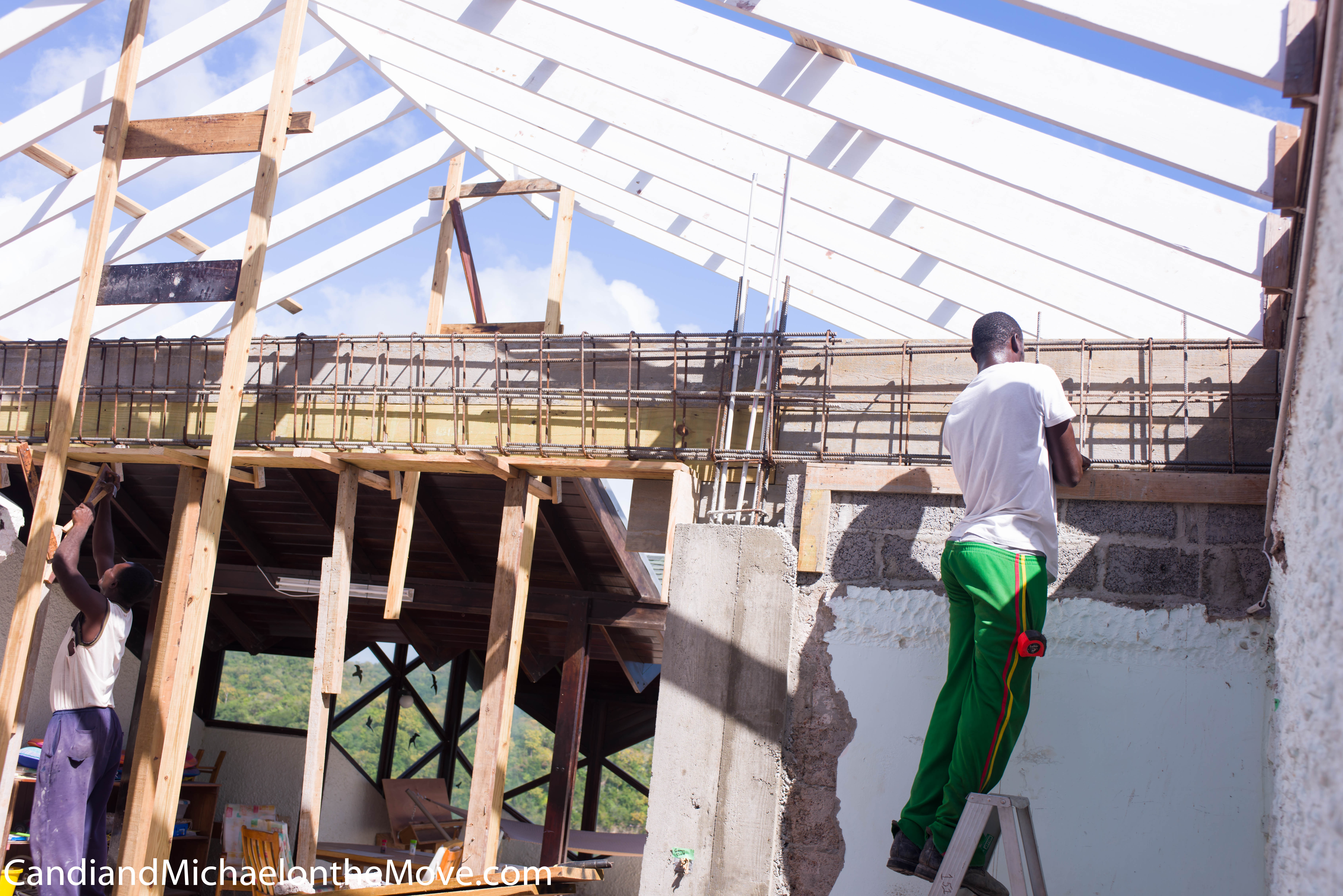
We’ve made a lot of progress this last week.  Demolition is great because it’s so fast.  Construction on the other hand can look almost the same, day to day, as internal infrastructure is created or shored up before new work is visible.  The front wall has been completed – the ring beam has been poured, with lots of buckets of cement hoisted up to the peak filling in the concrete block, plus a mold has been poured to make the roofline look nicely finished.  The back wall ring beam has also been poured and is curing.

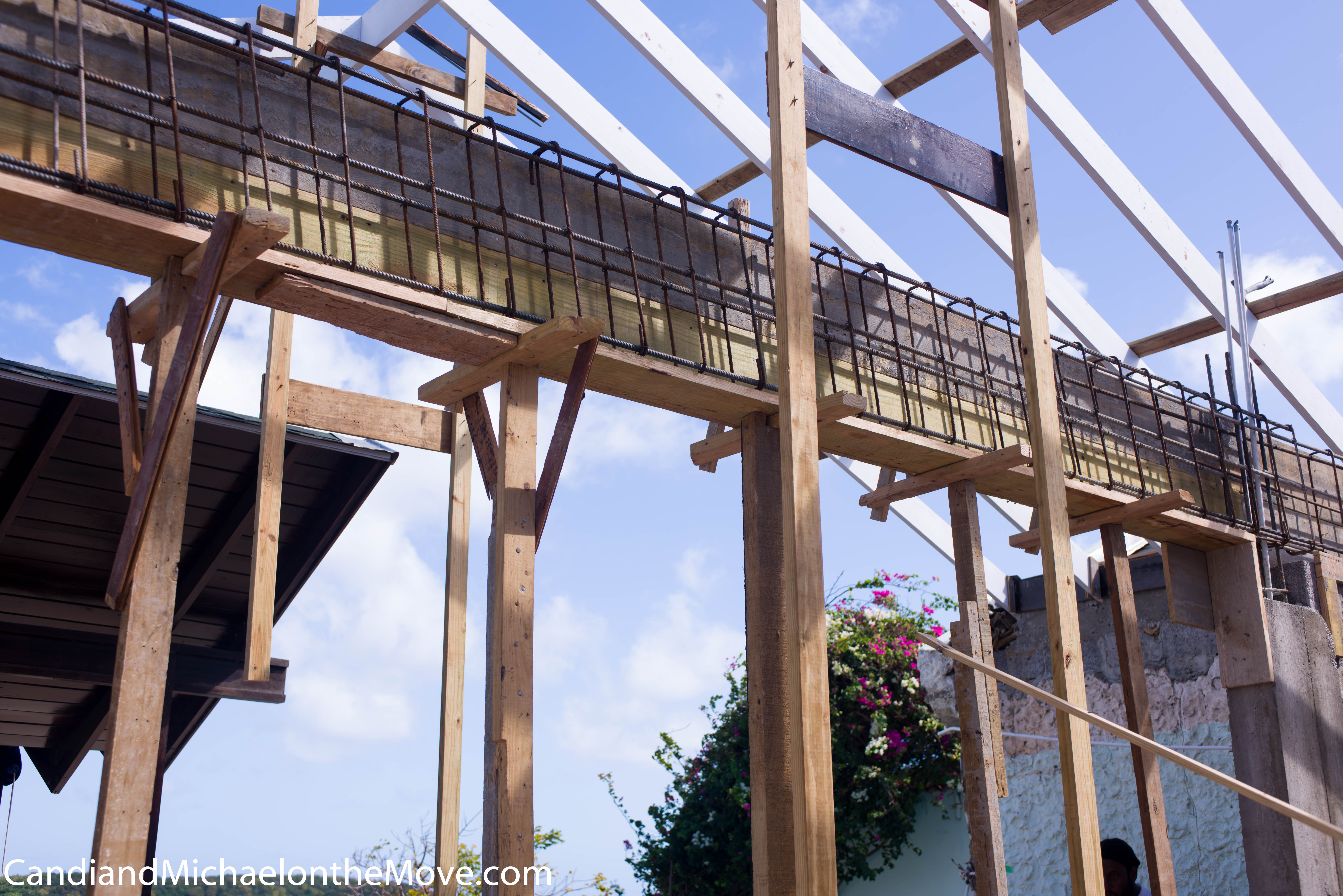
This is the ring beam which will make the house more hurricane proof. It will be completely filled with cement and tied into the other wall's ring beams.
This is the ring beam which will make the house more hurricane proof. It will be completely filled with cement and tied into the other wall’s ring beams.
Here they are starting to build a wooden box around the ring beam that will be the form for the concrete.
Here they are building a wooden box around the ring beam that will be the form to hold the concrete.

Now most of the focus is on building the infrastructure to pour the floor.  This is the critical path since there is a long curing period.  While the floor cures, work will resume on the roof.  And I’m hopeful that we will at least have the wooden ceiling in place by next week.

~ So long to the moonlit living room, hello to shelter.

Filed Under: Expat life, Grenada, Renovations, The Arches, Travel Tagged With: construction, expat life, Grenada, rennovation, The Arches, travel

Proceed at Your Own Risk ~ Driving in Grenada (Part 3 of 3)

April 16, 2015 by Candi Licence 3 Comments

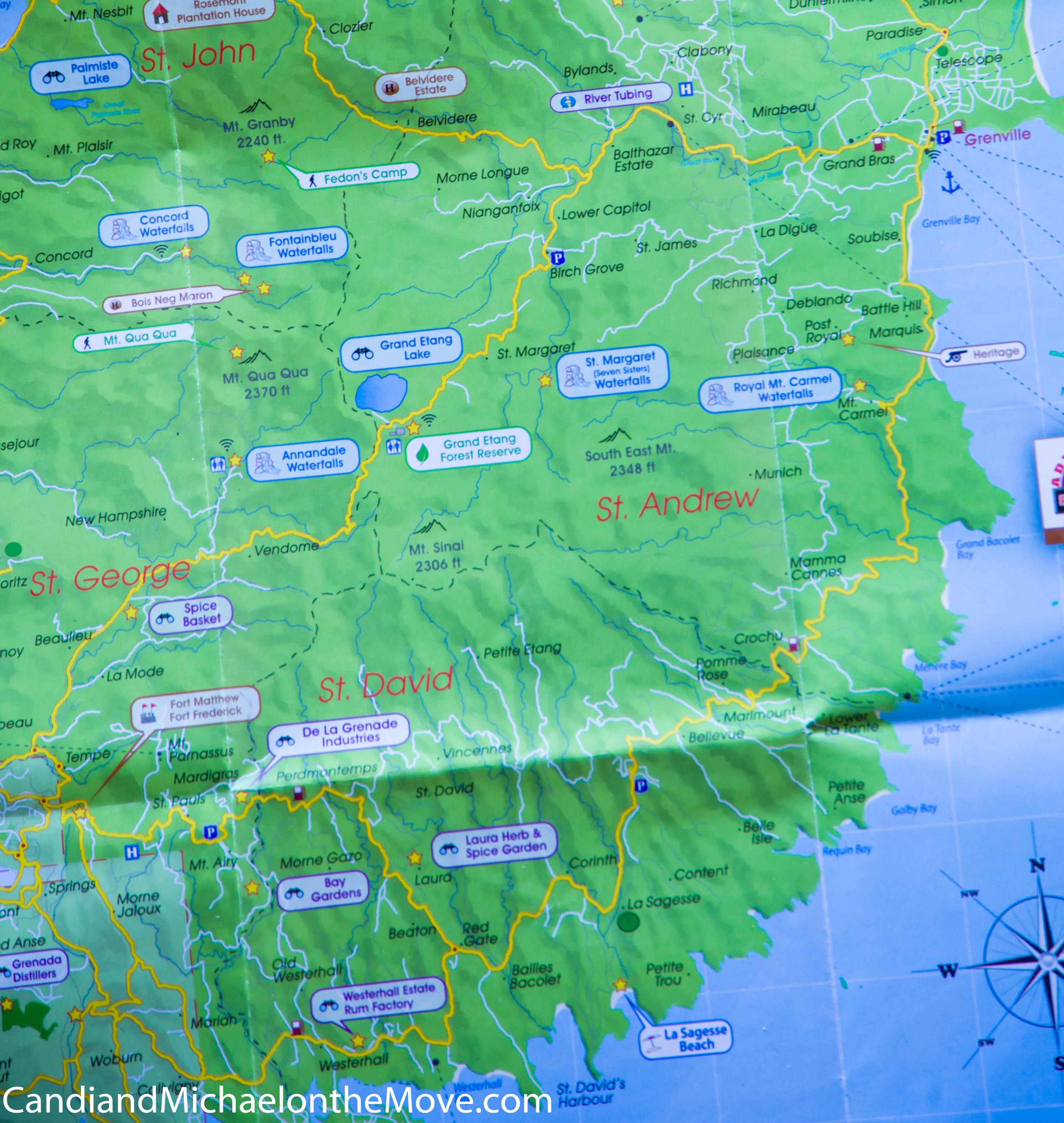
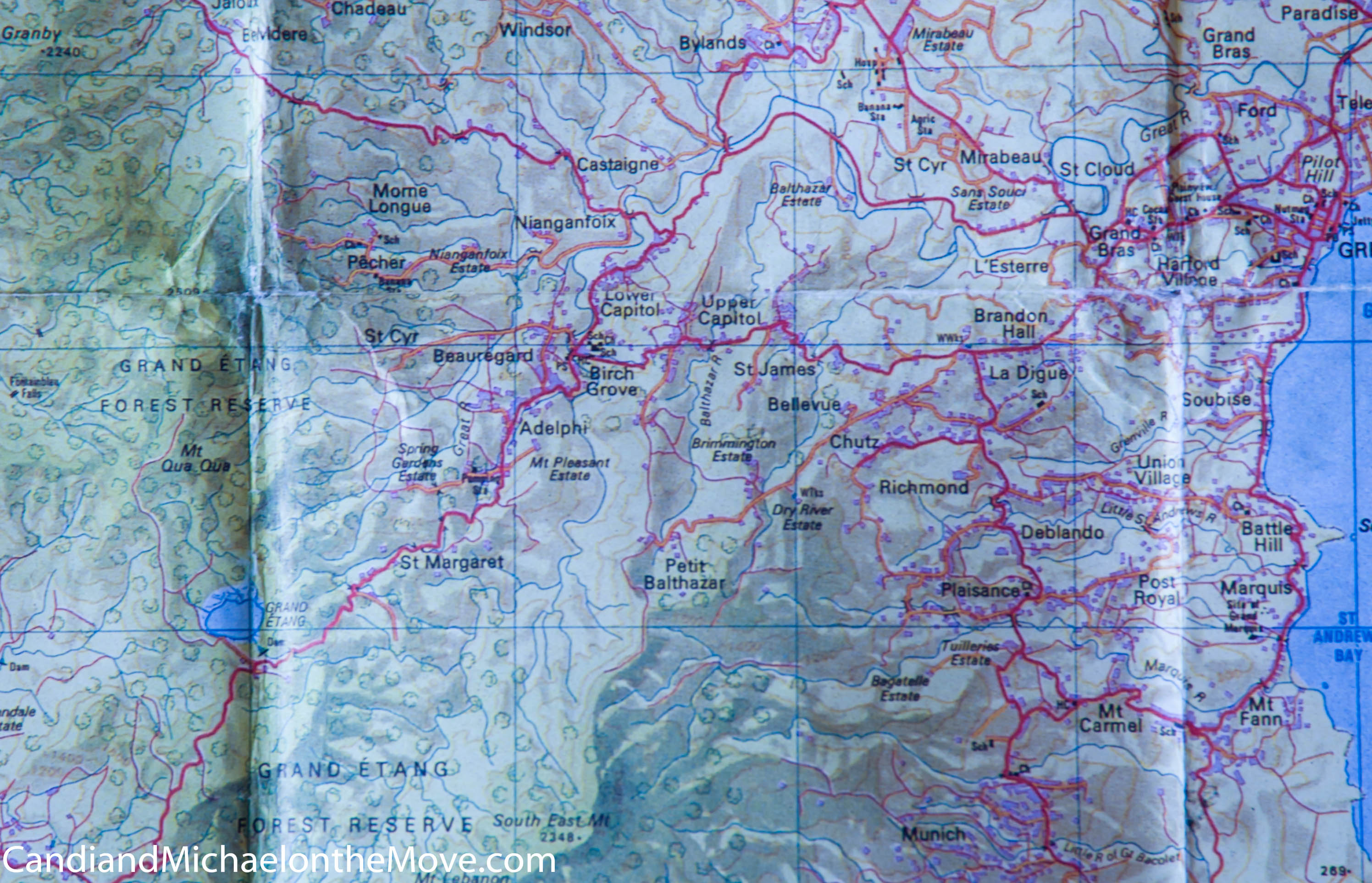
There are two road maps of Grenada, the Tourist map and a very detailed Government map.  The tourist map is totally worthless and only shows about five major roads.  You cannot get anywhere interesting with this map.  The government map is a gem and is prized like treasure once you find one.  Even though it was published in 1985, it is still highly accurate.  It has EVERY road on the island on it.  We usually carry two or three of the government maps with us because if a tourist sees us looking at one, they run over and start negotiating to purchase it.  We always give them away or sell them at cost, but I’m convinced we could make a good side business out of marking up the price.

The tourist map, with minimal roads displayed, makes it hard to get anywhere reliably.
The government map, on the other hand, has every road and shows every curve.

Most roads do not have any signage so I need to depend heavily (and completely) on the map. It is extremely accurate and shows every curve in every road so as we travel along, I’m tracing our path with my finger and watching for buildings that might have a town name on them.  This way I can confirm where we are and we only get slightly lost if we are in unfamiliar territory.  I find a town name, notice it’s not on our way and we turn around or I realize we are further along or not quite as far as I thought and recalibrate.   This year, I’m proud to say I’ve hardly used the map.  I know my way around and can usually figure out how to get somewhere I haven’t been to before with little trouble, but let’s be clear, I NEVER drive without maps in my purse and in the car.  We are even successfully taking shortcuts now!  Grenadians are often surprised that I know where their hometown is, even if it is way off the main roads or out in the country.  We’ve driven everywhere and probably to some places most Grenadians have never been to!

This is an example of a yellow road - 2 lanes, if you dare.
This is an example of a yellow road – 2 lanes, if you dare.

The government maps show 4 kinds of roads.  Thick red roads are major arteries – two lanes, YOOHOO!  Orange roads are secondary roads and are whimsically thought of as 2 lane roads – if there is nothing on the sides and both cars are creeping along, you can pass each other.  These roads may also be major ways to get between 2 places.  Next, are Yellow roads.  They are one and half lane roads, are usually paved (but not always, and not in all places) and then there are the little red roads – my personal favorites.

Little red roads mean ADVENTURE – tourists rarely travel these roads, the roads can stop at any time or they can take you to the best places – deserted beaches, tiny villages where you can find wonderful things and have a chance to talk to people for hours, old plantations, waterfalls, rivers, etc.  Little red roads start out with concrete or blacktop, then become broken up pavement, then grass, then small boulders and might go over small streams.  It’s reminiscent of the old print advertisement for either Range Rover or Land Rover that shows their vehicle bumping down a rutted road in a muddy stream and says “in some parts of the world, this is not off-road driving”.  YES, my kind of road – particularly when Michael is driving, bless his heart.  I didn’t really realize what I was putting him through until I started driving and my better sense would say – don’t go down that road, you might never get back and realizing he always did AND we got back.  That’s my wonderful guy.

The best little red road story starts one day when we went into the rain forest looking for an old plantation that had been turned into a delightful plant nursery.  This lovely place is a whole different story, but as we were coming back I saw a significant shortcut to get to St. Georges that would cut off at least 30 minutes of driving.  So off we go.  The road turns from concrete to blacktop, the blacktop begins to break down, the road then turns to dirt, then to two furrows of dirt with grass growing up in the middle, and, finally, really tall grass is growing in the middle.  All this time we are driving up, up, up to go over a mountain with St. Georges directly on the other side, tantalizingly close. As the road goes up, it keeps getting narrower and we begin to wonder if it will go all the way through, but there is no one to ask – no shops and no houses except a really tiny shack hanging off a cliff a ways back, but it was all closed up and no one was home so we couldn’t ask for directions.   I keep thinking if we just go a little further we’ll be good – it’s like a mirage.  It would be OK to keep driving on if we were sure it went through, but we didn’t know if it will just stop or get wider and head down the other side of the mountain.

Finally, Michael has had it – the first and only time he says we’re turning back.  This is a figure of speech.  The road is way too narrow to turn around.  In fact, I can touch the mountain on my side and Michael is inches from the steep drop off.  I wiggle my way out of the car – I can hardly get the door open a foot and I contort and then inch my way to the back of the car, leaning hard into the side of the car and feeling the bush brush my back.  I then begin directing Michael back down the mountain – 2 inches to the left, three inches to the right, as he slowly descends the curvy road.  Finally, I see someone driving a pickup truck up the road near the shack we had passed.  I tell Michael to stay put and I run down to meet him.  Even before I open my mouth, he gives the answer to my unasked question when he says, “Darling, what are you doing in this godforsaken place?”  The “road” ahead hasn’t been navigable by car for over 10 years.  Oh well, we continue to inch back down the mountain until we get to the shack and can turn around and drive normally.  My shortcut only took an extra hour and a half, but what an adventure!

The Government map is great navigation tool, but I also have to be very vigilant since the main roads and the secondary roads that lead off of them often look the same size and both are well-traveled.  And because the roads are so curvy, it’s often hard to determine the direction of the main road.  Often I’d look at a junction and tell Michael to go straight because looking at the map and then the roads it was obvious to me which way to go to stay on the main road.  He’d bellow in amazement that straight wasn’t an option (he’d be right) and I soon opted for saying ‘go up’ or ‘go down’ because left or right was often not accurate either.  You are always going up or down in Grenada, almost nothing is flat anywhere.

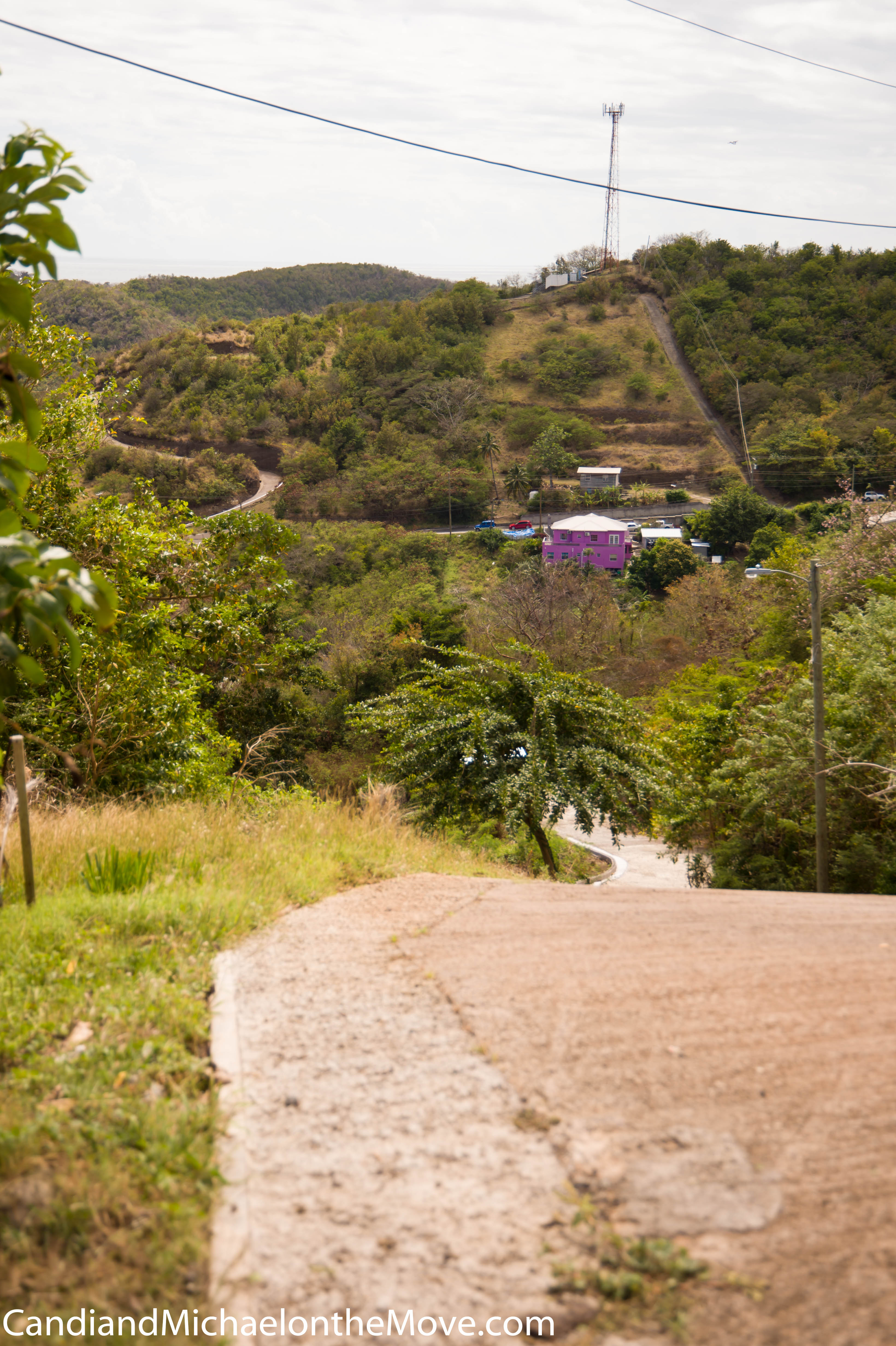
This picture shows 3 examples of steep roads.  The big road is the one we live on, the curvy one in the background on the left goes to a new development, and if you look hard you cn see a road coming down from the cell tower - it goes almost directly straight up.
This picture shows 3 examples of steep roads. The big road is the one we live on, the curvy one in the background on the left goes to a new development, and if you look hard you can see a road coming down from the cell tower – it goes almost directly straight up.

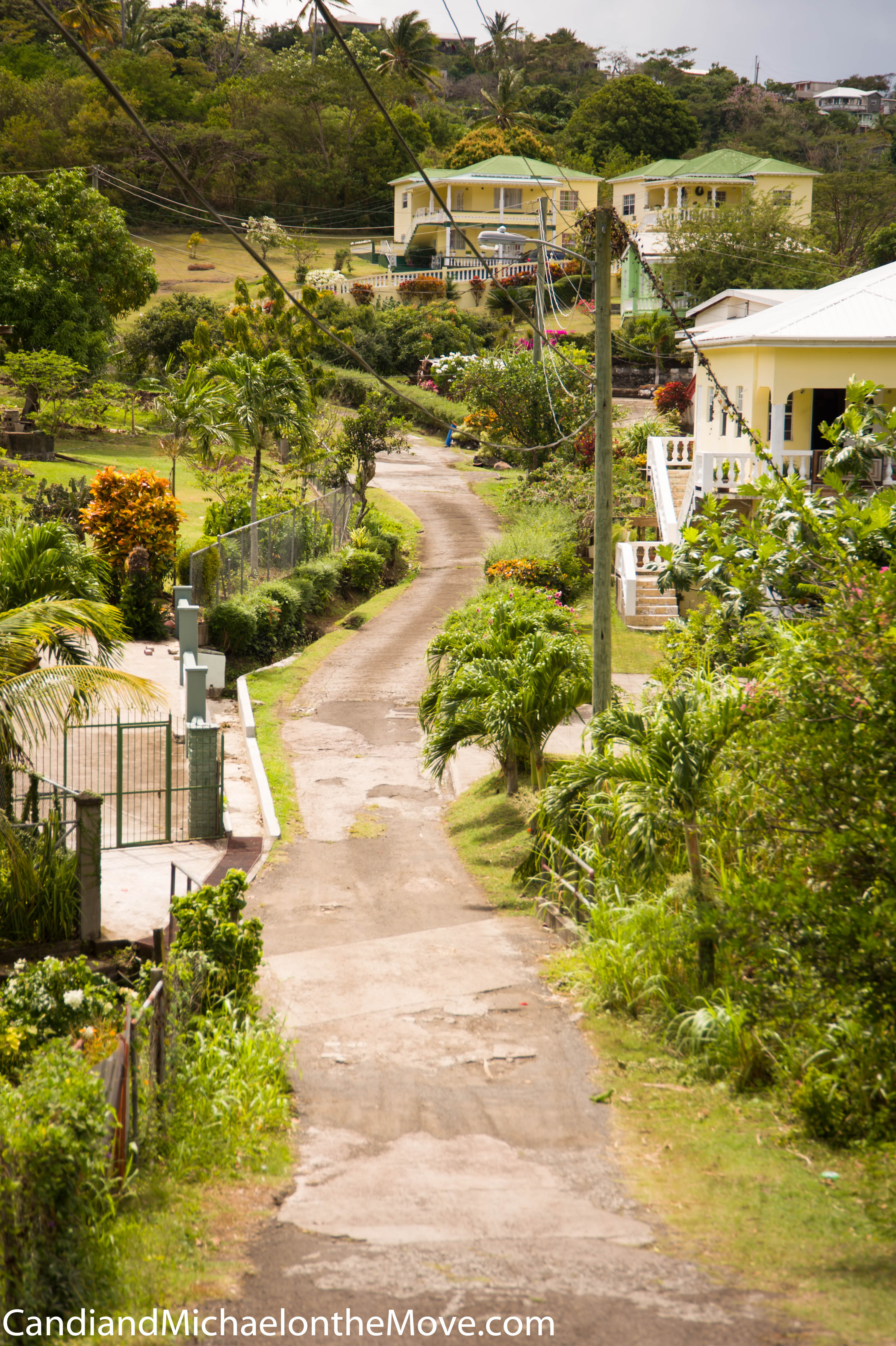
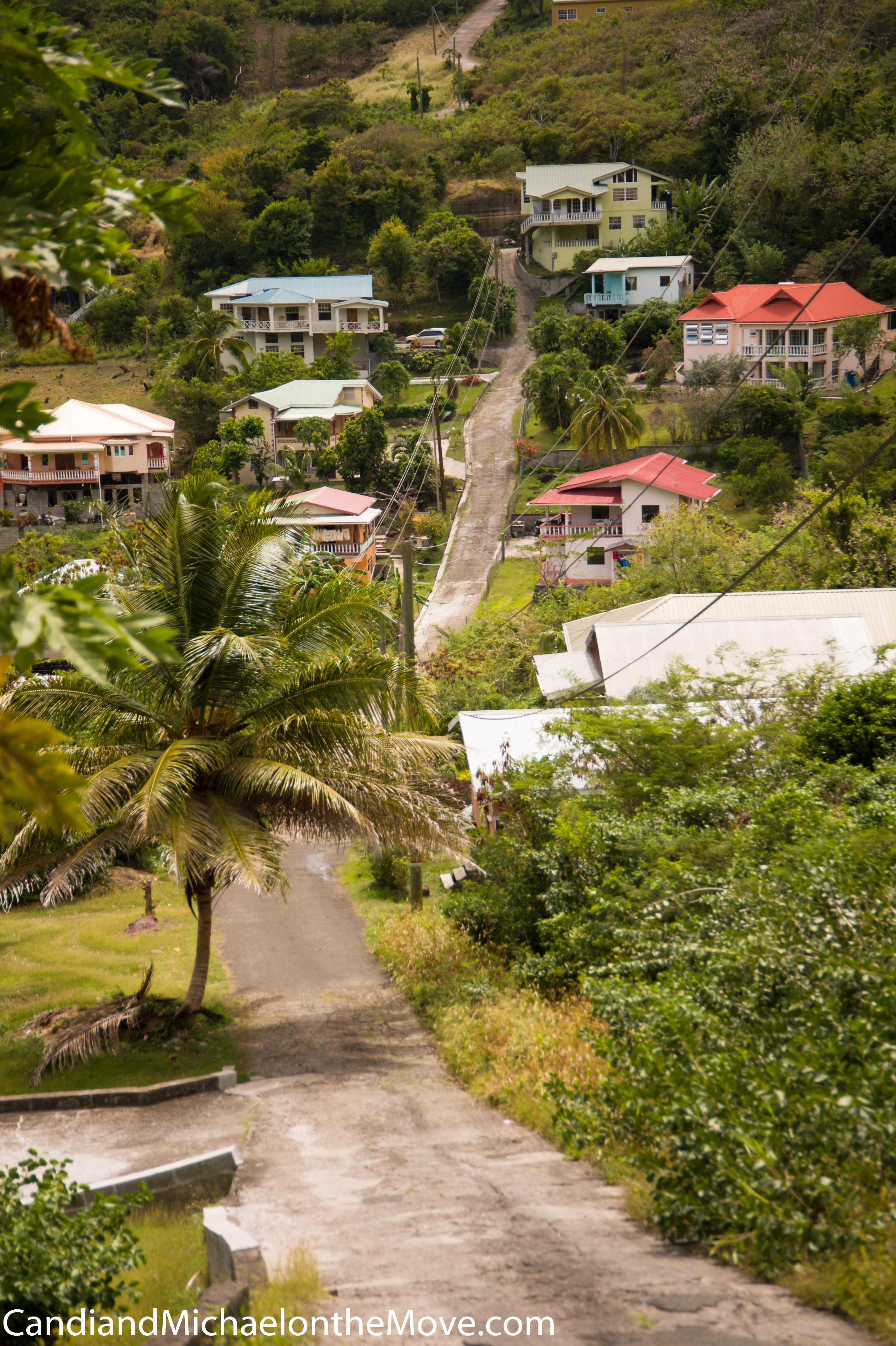
In addition to curvy, narrow roads, Grenadians have built roads straight up that make you dizzy just looking at them – forget actually driving on them.  They are that steep.  First you wonder how anything can drive up or down the road.  Then you get brave and try the road and are afraid your car will flip backwards before you reach the top of the hill, never mind that the road might curve right at the crest and if you could actually see something besides sky, you would know to turn your steering wheel sharply to the left or right to follow the road as you go over.  We were on one such road a few years ago and it began raining really hard.  We stopped for a moment and the car started slowly slipping backwards because we couldn’t get enough traction on the scored concrete with our balding tires to stay in one place.  So, what did Michael do?  He just slightly turned the wheel and let the car keep slipping until we backed into a wall, then turned around and inched down in first gear.  The seat belts were the only thing keeping us from falling into the windshield.  Unbelievable!

It's hard to show perspective in a picture but notice that the houses are close together and that the roofs are at the base of the next house
It’s hard to show perspective in a picture but notice that the houses are close together and that the roofs are at the base of the next house

There are a couple of roads close by that I’m getting my courage up to drive over because I want to see what is at the end.  On one, I can see a group of houses and this is the only road in and out so someone is definitely driving on this road.  I almost had a heart attack watching a full-sized cement mixer head down with a full load the other day – inch by inch.  I never saw him come back up but I’m hopeful he’s not still down there.  (There is actually another place that has a large construction truck stuck at the bottom and odds are it will rust out there since they can’t get it back up the hill.)  The very steepest roads are often not 2 lanes wide (although they accommodate 2 way traffic by having one person pull over to let the other person pass) – if there is room to pull over.  Otherwise, one car has to back down part of the way until they reach a spot to be able to pullover so the other person can pass.  This can be a common occurrence depending on where you are driving and is nerve-racking to say the least.

My other favorite driving story is going down a narrow, curvy road and trying to inch around parked cars at a popular bakery.  This road had huge, deep drains on either side to move the immense amount of water that comes down during a big rainstorm.  I’d estimate the drains to be about 16 inches deep and 12 inches wide.  None of the drains have grates over them, you are just supposed to stay out of them.  As we were inching by, trying to follow the other cars, we dropped our front left tire into the drain, effectively bottoming out the car.  (This was probably because Michael was trying to keep a complete 2 inches of clearance on his side.)   Michael and I looked at each other wondering how we would ever get out of this situation while a bunch of Grenadians stood by laughing.  Then 8 or 9 men walked over, picked up our car, set it gently on the road, patted the trunk and we were on our way.  Amazing!  (They have since widened this road because the big trucks travel on this road, but now everyone parks along the sides so if feels just as tight as it used to.)

I’m laughing as I finish writing this because I’m wondering if anyone will drive here after this description, but we do it all the time, day and night, and other than being on hyper alert, it’s a Grenadian experience in and of itself.  This year, due to the economy, there are less drivers on the road.  The price of gas is just too high for most people to be able to afford it – so their cars sit and wait for better times.  I’m sad about this, but thankful because this makes it that much easier to get around.  I’ve been driving a lot by myself this year because Michael has had non-stop photo shoots and I’ve gotten really good and relaxed about driving .  I’m hoping my ability to navigate tight spaces and my increased confidence will make driving easier when the roads fill up again next year, “please God”, as the Grenadians say.

Happy Motoring!

Filed Under: Grenada, Travel Tagged With: driving, Grenada, travel

Proceed at Your Own Risk ~ Driving in Grenada (Part 2 of 3)

March 31, 2015 by Candi Licence 2 Comments

Driving at night is another challenge. 95% of the roads have no signs so it helps if you already know the way to where you are going. There is no such thing as a center line to imply two sides of the road, often no streetlights and I never realized how much I relied on the white line on the side of the road to provide a clear boundary. Here, the edge of the dark road fades into more darkness and you never know what is lurking a few inches off the side of the road. Is it an uncovered drain, a sharp drop off, a sleeping dog? Are there potholes lurking (usually) or people walking (of course)? It’s the things that move – people, cars and animals that are most scary and have the most potential for disaster. Often a dark person, in dark clothes, is walking on a dark road while oncoming cars are blinding you with their headlights. Getting around at night, on foot or in a car, is not for the faint at heart.

The windshield is always blurry, covered with years of road grime and rubber from ancient windshield wipers. I know it sounds like an easy fix, to just wash the windows, but experience tells me it won’t help. We’ve washed our windshield multiple times this trip – with Windex at first, then vinegar and newspaper, then a green scrubber with a lot of elbow grease and a mixture of grease solvent and bleach – and the windshield doesn’t even look marginally better. So, as headlights are coming at you and are refracted by the dirt and therefore blinding you, you try to instantly memorize the curves and obstacles ahead, keep your eyes slightly diverted from the glare and remember, once again, how convenient that little white line on the side of the road would be in keeping you safe and on track, if only there was one. Driving at night is a series of starts and stops with many slowdowns in between and we always sigh with relief when we pull safely into our driveway.

If you are not inclined to drive, you can always opt for the shotgun seat. This is the Seat of Terror. You see and experience all the same views but with no control over the outcome. I first realized this when Michael’s Mom came to visit. Being polite, I seated her in front on the way home from the airport so she would have an unobstructed view of our beautiful island. The next time we went out, I offered the front seat again and she recoiled in terror and loudly proclaimed that she absolutely did NOT want to see where we were going, thank you very much. I think if I had a blindfold available she would have gladly taken it. Now I still offer visitors the privilege of the front seat but with more caution.

Grenada is a volcanic island and there is a beautiful dormant crater in the center of the island, high up in the rainforest. Of course, since this is Grenada, there is also a treacherous road that weaves its way up and over the mountain to the other side of the island linking the 2 largest cities – St Georges, the Capital on the west coast and Grenville, a large fishing and commercial center on the east coast. Since these are the two largest and most populous cities, and this is the only major road through the mountains that connects the two coasts, this is also the primary bus route between these cities and to other towns on each side of the island.

Buses are privately owned and operated and the more trips they make in a day, the more money they earn. This encourages trips at literally breakneck speeds over curvy, wet mountain switchbacks. If you are in front of them, they relentlessly tailgate you, inches from your bumper and constantly try to pass on the wrong side of the road, swerving back as a car comes around the next curve – and they also beep at you to speed up. Conventional wisdom says just pull over and let them pass – even if you have to do this many times. The only problem with this idea is there is often nowhere to pull over. Once in a while, you’ll see a place where the road is marginally wider but no sane person would stop – and you do, anyway. Finally relieved that the maniac behind you is leaving you in their dust, you start up again and within minutes there’s another bus taking its place. Buses don’t run on Sunday so that’s the most “relaxing” time to drive over the mountain and to enjoy the rainforest and the Grand Etang Lake at the center of the country. Recently, Grenada has tried to introduce the concept of a bus schedule which has slowed the busses down considerably. Now they are only a hair-raising nuisance on this treacherous road.

It’s a tossup on whether you want to be on the mountain side or cliff side of the car. On the mountain side you can literally reach out and almost touch the wall as it whizzes by. If you are lucky enough to be on the cliff side you have two choices – looking out the side window at the sharp drop off, inches from your door, OR watching out the front window and seeing the places where the road surface is disintegrating and falling away down the cliff. Otherwise, you have the pleasure of looking face to face with the driver careening towards you from the other direction, on a road you are sure is too small for both of you to fit. On each trip, you get to experience both sides and after many trips I sadly think the inside wall is only marginally better. The upside is the breathtaking views of the rainforest, other mountains, valleys and vistas all the way to the seas, every way you look.

In either case, you often get a wet, slippery road. It is the rainforest after all. Believe it or not, this is a ride I look forward to each year and encourage others to take for its dramatic beauty. You only get to enjoy the view if you are not driving. There is no time to take your eyes off the road for an instant if you are the driver. And as the navigator, you still need to be watching all the curves and side roads so you can make instantaneous decisions on which is the “main” road.

Then there is the concept of guard rails – be careful what you wish for. There are very few guard rails in Grenada. When you do see one, you notice it because it usually means the road has rotted away and they are trying to give you a chance of not completely falling off the road. The road is narrower at this point and often just a little bit soft as you drive by. Lovely. Guard rails are overrated anyway.

In one of our earliest trips to Grenada, when we were going from St. George’s to Grenville and back in the same day, I got us lost on the return trip. It would be way too easy if there was only one road, but no, there are multiple roads that veer off towards tiny villages.   These roads often don’t look any different from the main road. Plus, on this trip, when I realized we were off the main road (about 30 minutes later), I thought we could take an alternate road to St. Georges, based on the map. Of course, after following it for another 30 minutes or so we realized it was no longer useable so we had to backtrack for an hour and start again. By now it was getting dark and we were probably over an hour away from the edge of St Georges if you were driving in daylight, 2 hours in the dark – if we don’t get lost again. With a trusty flashlight, reading our map, I try to navigate Michael to safety. The only thing possibly scarier than looking off the cliffs during the day is seeing your headlights disappear in the darkness at night and trying to figure out where the road is going to turn next. Buses are still whizzing by, but too fast to use them as a beacon to follow for more than 1 or 2 curves, then back to the blackest black. Where are the guard rails and that little white line on the side of the road to guide us?

Finally, we pass a group of men and stop to check that we at least are on the right road and one person offers to jump in the car and direct us. We hesitate – do we want to pick up a stranger in an unknown place, when we don’t really know where we are going, or continue on our own? Michael and I look at each other and I open the back door to let him in. Of course, he is a great guy. Most people in Grenada are delightfully wonderful and the people are the main reason we loves this special place. He leans way into the front seat between us and directs us left, right, left, right, left, left, down, down, down the mountain and into town. After dropping him off, we head back to our villa. It is about 8:30. Michael has been driving on and off since about 10 AM, with the last 2 hours driving in the pitch black. He just sits in the driveway, staring into space while I try to pry his fingers off the steering wheel. No exaggeration. We go inside, I make him a Gin and Tonic and he doesn’t speak for 30 minutes. I still remember this trip in full detail 20 plus years later. I’m sure he does as well. We have never made this trip at night again.


Filed Under: Grenada, Travel Tagged With: driving, Grenada, travel

Proceed at Your Own Risk ~ Driving in Grenada (Part 1of 3)

March 29, 2015 by Candi Licence 2 Comments

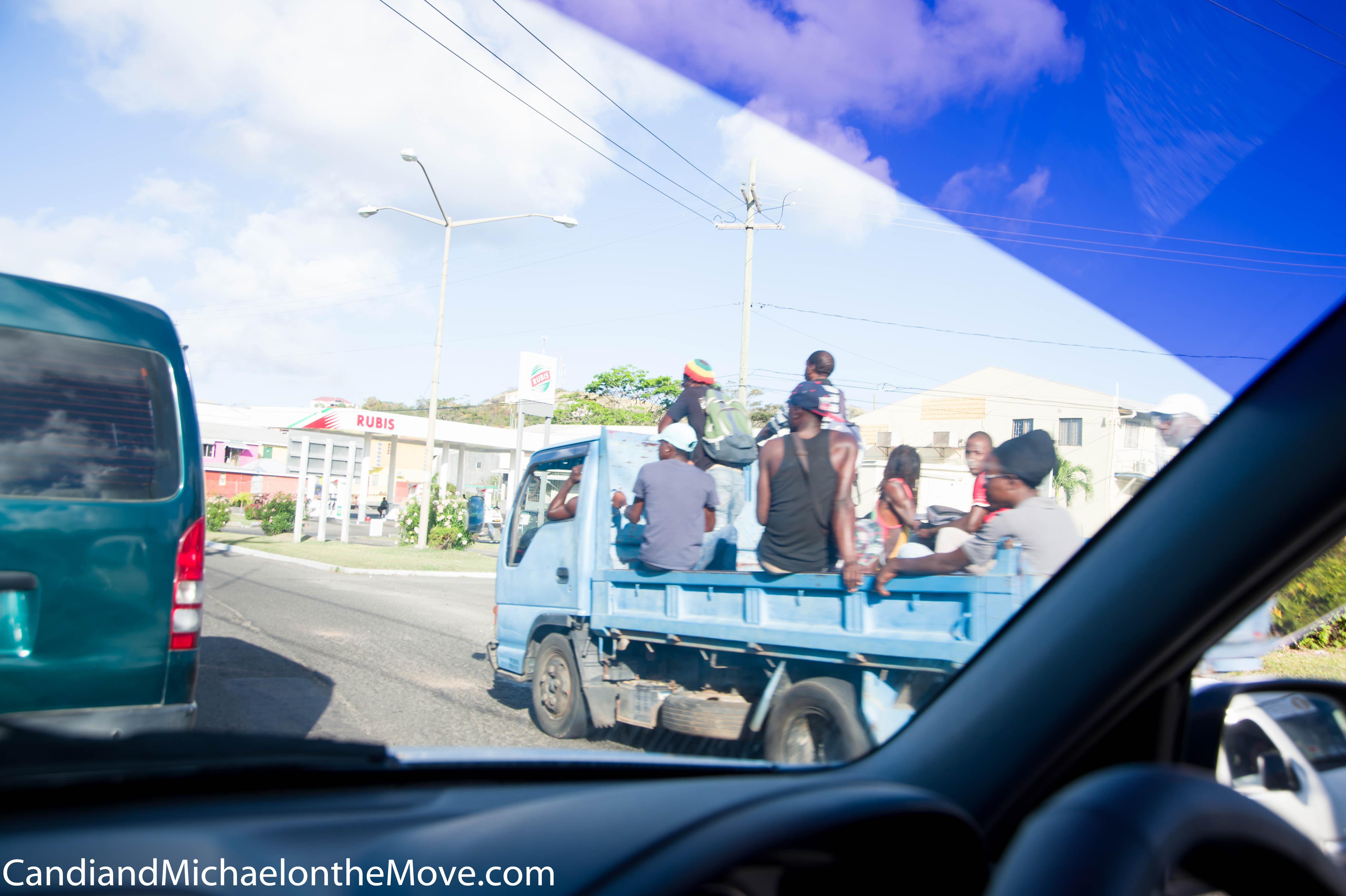
The worst time to be driving in Grenada is around 5:00 PM on a Friday.  People are hurrying to get home to start their weekend, they have just gotten paid and are in a party mood, plus all the large construction vehicles are barreling through town and taking up more than their share of road.  These large trucks are filled with workers just barely hanging on and spilling over all the sides.  It feels like a recipe for disaster.

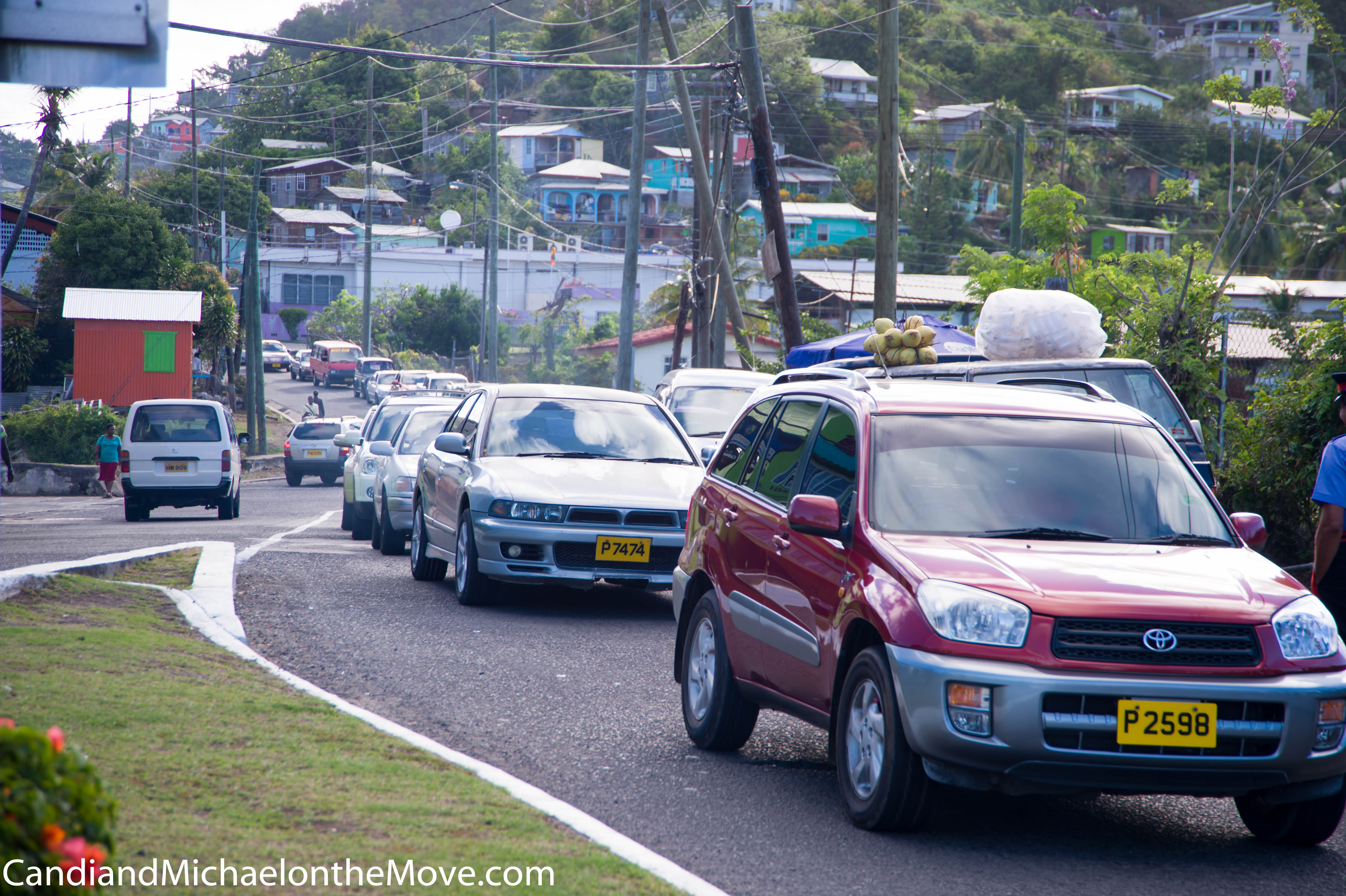
This is one entrance to the Sugarmill roundabout when it's NOT crazy.
This is one entrance to the Sugarmill roundabout when it’s NOT crazy. Notice the long line of cars in the distance, waiting to enter and multiply it by 4 other roads converging into the roundabout.

I think the worst specific place to be at 5:00 on a Friday evening is at the Sugarmill roundabout – a 2 lane roundabout that connects the arteries that lead to the Airport and the University, the main road into and out of Saint George’s (Grenada’s Capital and largest city), the main road to the Southeastern side of the country where the most people live and a major side road to one of the largest and oldest tourist areas.

And then there is me, …. trying to navigate through the madness …. I didn’t plan this …. I tried NOT to be here on this day, at this time, but the inevitable business delays that happen conspired to have me be exactly here – at exactly this time.

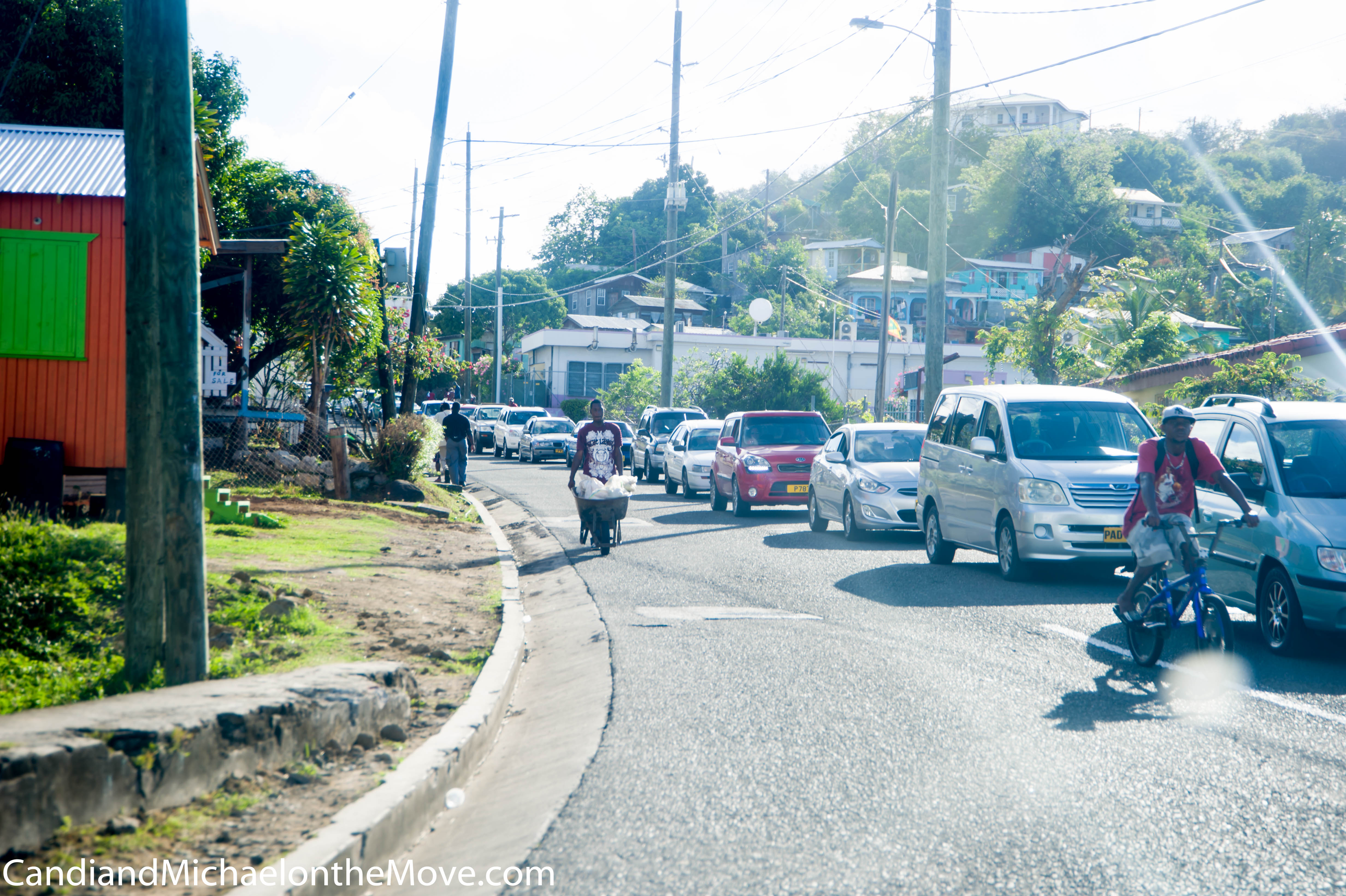
Coming out of the roundabout one morning.  Notice theman waking his wheelbarrow .... in my lane.  No sidewalks here.
Coming out of the roundabout one morning. Notice the man on the left walking his wheelbarrow into town …. in my lane. No sidewalks here. No pressure, just watch out for him, the kid on the bicycle, and unforeseen surprises while being tailgated by a bus.

Imagine this scene – the roundabout, which is England’s answer to managing traffic without using a traffic light, is 2 lanes wide with four feeder roads converging.  Everyone (hopefully) is driving on the “wrong” side of the road, going around the “wrong” way – clockwise.  In addition to what feels like all of the country’s traffic trying to funnel through this insane intersection, add the following to the congestion – a major bank, one of the largest gas stations on the island, a supermarket, lots of small shops including the popular Fish and Chips take out plus multiple street vendors on the sides selling barbecued chicken, roasted corn, soups, drinks and anything else they think people with fresh money in their pockets may want.  This is also a major bus interchange with buses only sometimes stopping in their designated places.  Other times, they just stop in the road, blocking traffic.  Of course, this means there are a large number of people walking or running to catch a bus home. There is a cross walk right at the roundabout – but only across one road.  On the other sides, people just make a run for it.

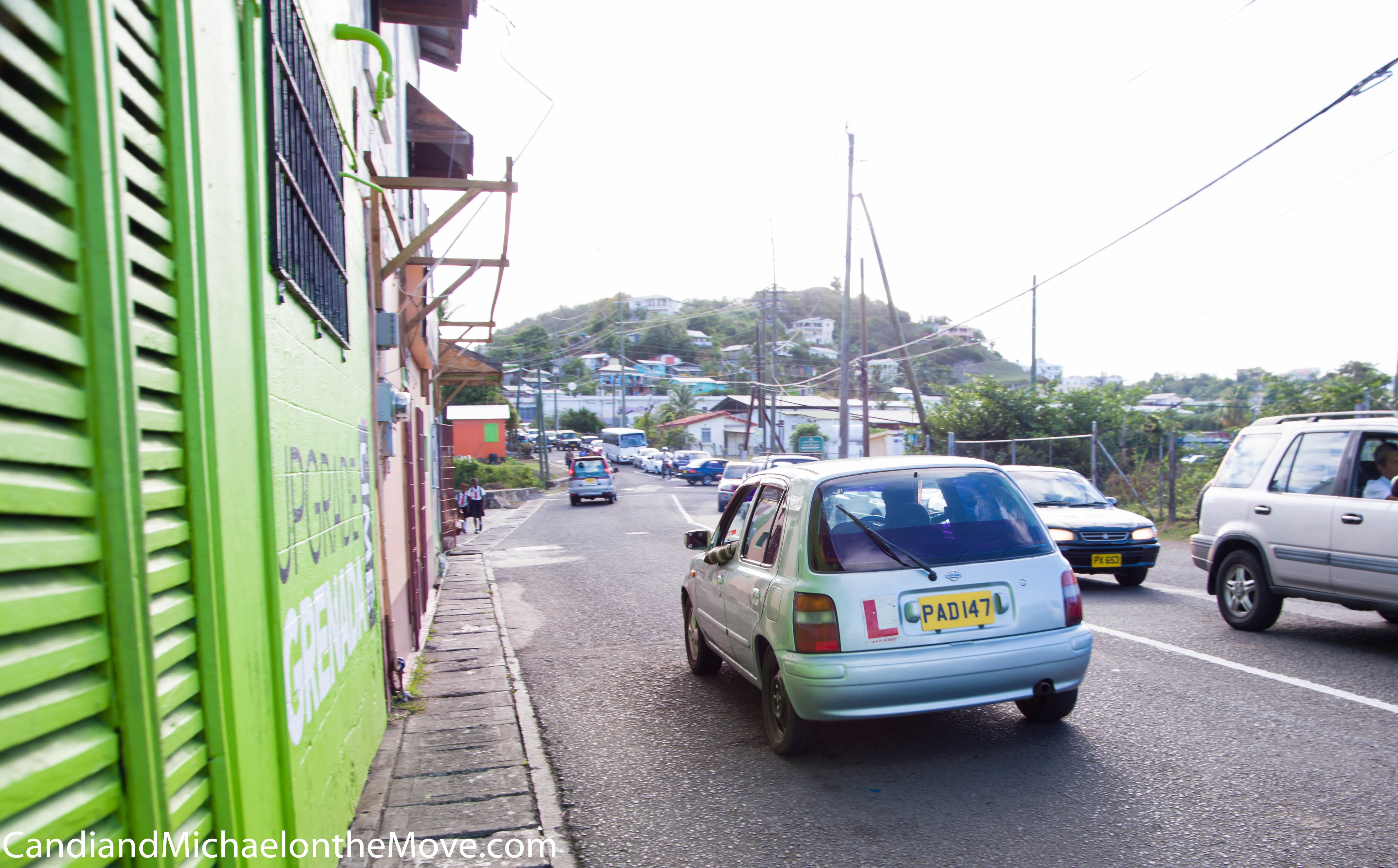
And yes, at least one "learner" added to the mix to make things interesting.
And yes, at least one “learner” added to the mix to make things interesting.

And then, in someone’s wisdom, there is always someone learning how to drive.  The learner is always boldly identified with a large red L hanging off the back of their car.  They are clearly terrified and completely unpredictable – either jutting out into the traffic at the worst possible moment or squandering their chance by sharply braking for no apparent reason, distracted at something happening on the other side and missing a golden opportunity to head into this complicated dance of vehicles.  Logically, this makes sense, they will have to drive through this mess as an independent driver so they should get experience, but it makes everyone an emotional wreck.

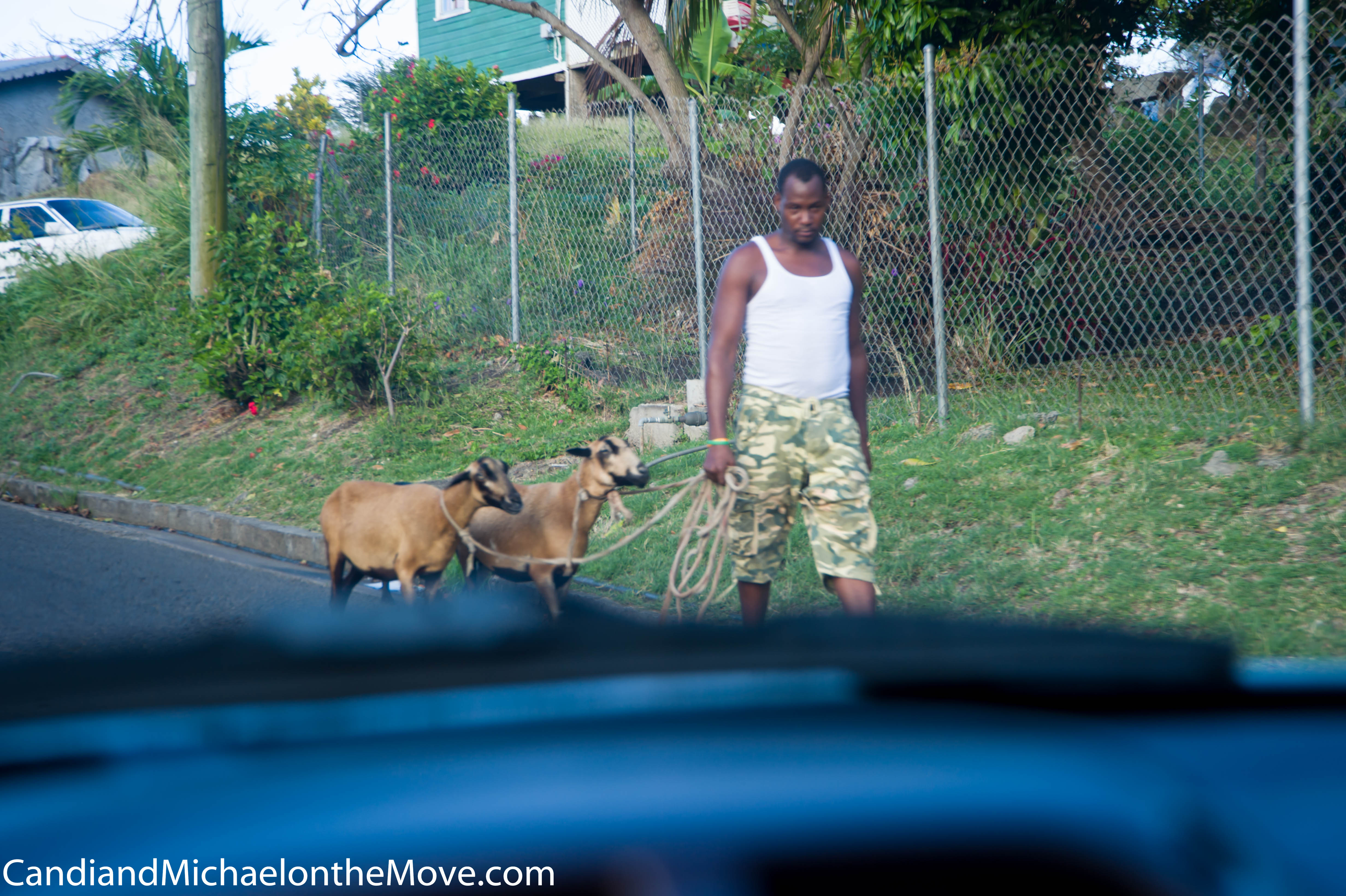
Couldn't get a snap of the man with all the goats but here is another very familiar sight.  You can see goats anywhere all the time - being walked to and from a tethering place.
Couldn’t get a shot of the man with all the goats but here is another very familiar sight. You can see goats anywhere all the time – being walked to and from a tethering place.

Oh, and did I mention the goats?  Some man is taking his goats’ home for the evening and of course has to pass directly through the center of the roundabout.  He has the 7 adults tethered on individual ropes and is weaving them through the congested cars.  OK, that’s not too bad but he also has an uncountable number of baby goats as well.  Baby goats are rarely tethered since they will not stray far from their parents.  They are like the terrified learners and they dart and lurch unpredictably between all these cars, trucks and people.  Miraculously none get squashed and if you have the ability to step back and watch the scene as an observer, it is quite funny and amazing.  However, I don’t really have that luxury as I’m in the middle of this mess trying to navigate through it without killing myself or anyone else.  I finally shoot through the other side and feel like I’ve been expelled from a white water river current.   Now I just have to get through the valley and past the major marina construction site and then I’ll only have to contend with everyone racing home in one of two directions.  Piece of cake.

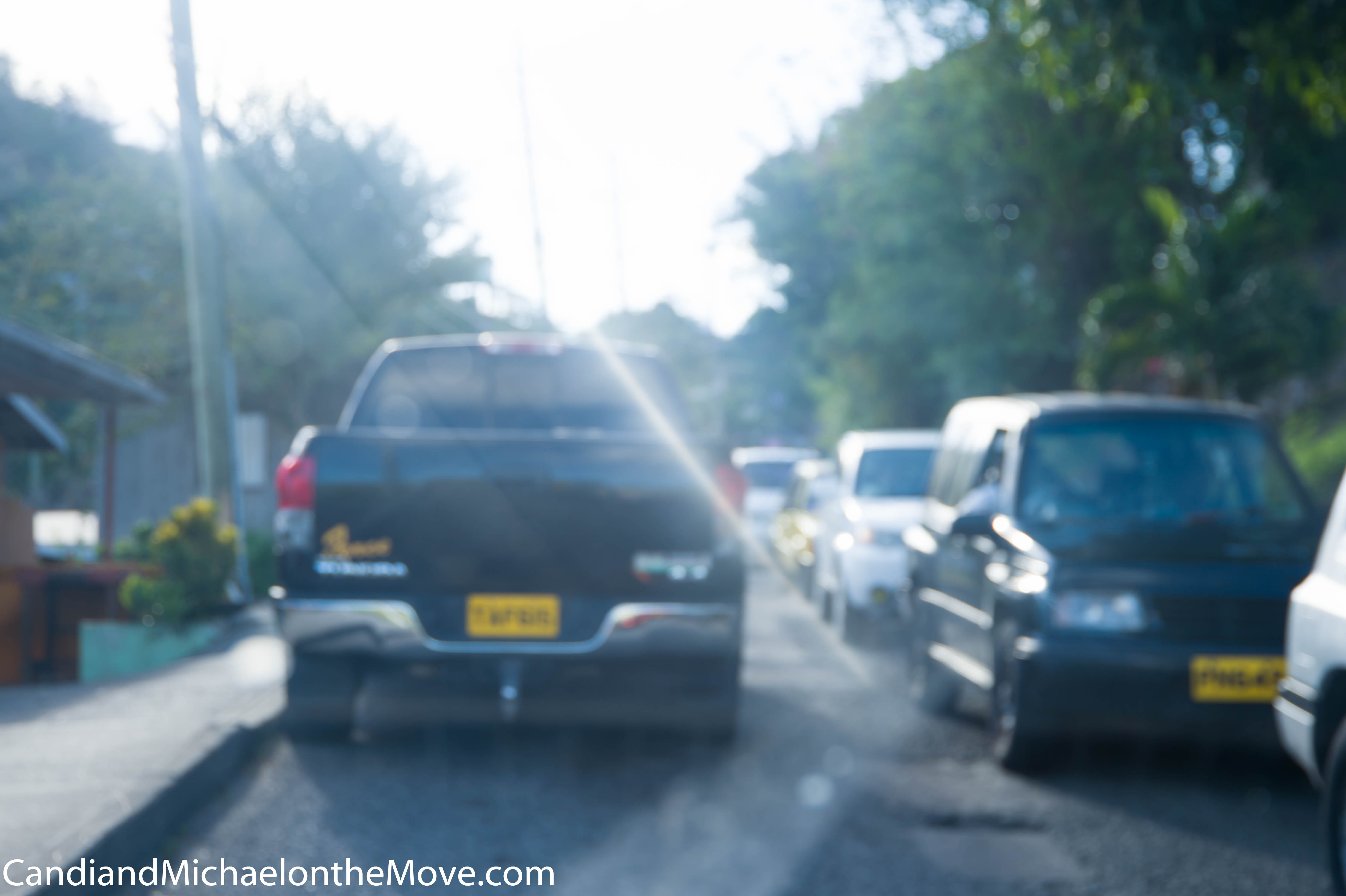
Here is a typical view on the major road around the island.  In the US, this would be equivalent to a parkway.  The left lane is entirely blocked by a parked truck so you wait for the cars to stop coming in the other direction and then race around the parked car before more cars come.  It's often a game of chicken.  Do NOT play against busses, taxis or trucks - they always win.
Here is a typical view of the major road around the island. (In the US, this road would be a four lane expressway – in each direction.) The left lane is entirely blocked by a parked truck so I wait for the cars to stop coming in the other direction and then race around the parked car before more cars come. It’s often a game of chicken. CAUTION: Do NOT play against busses, taxis or trucks – they always win.

Driving is on the left and my steering wheel is on the right.  Most major roads are just barely 2 car widths wide (the others are smaller), there is no room for parking and no sidewalks so everyone walks in the street and people park anywhere they can.  This necessitates a complex dance of cars moving in opposite directions, continually stopping and swerving around human, animal and vehicular obstacles.  Many people run small shops along the road, sometimes out of the front of their houses, and on Friday night everyone is cooking and trying to pry a few dollars out of the hands of people passing by.

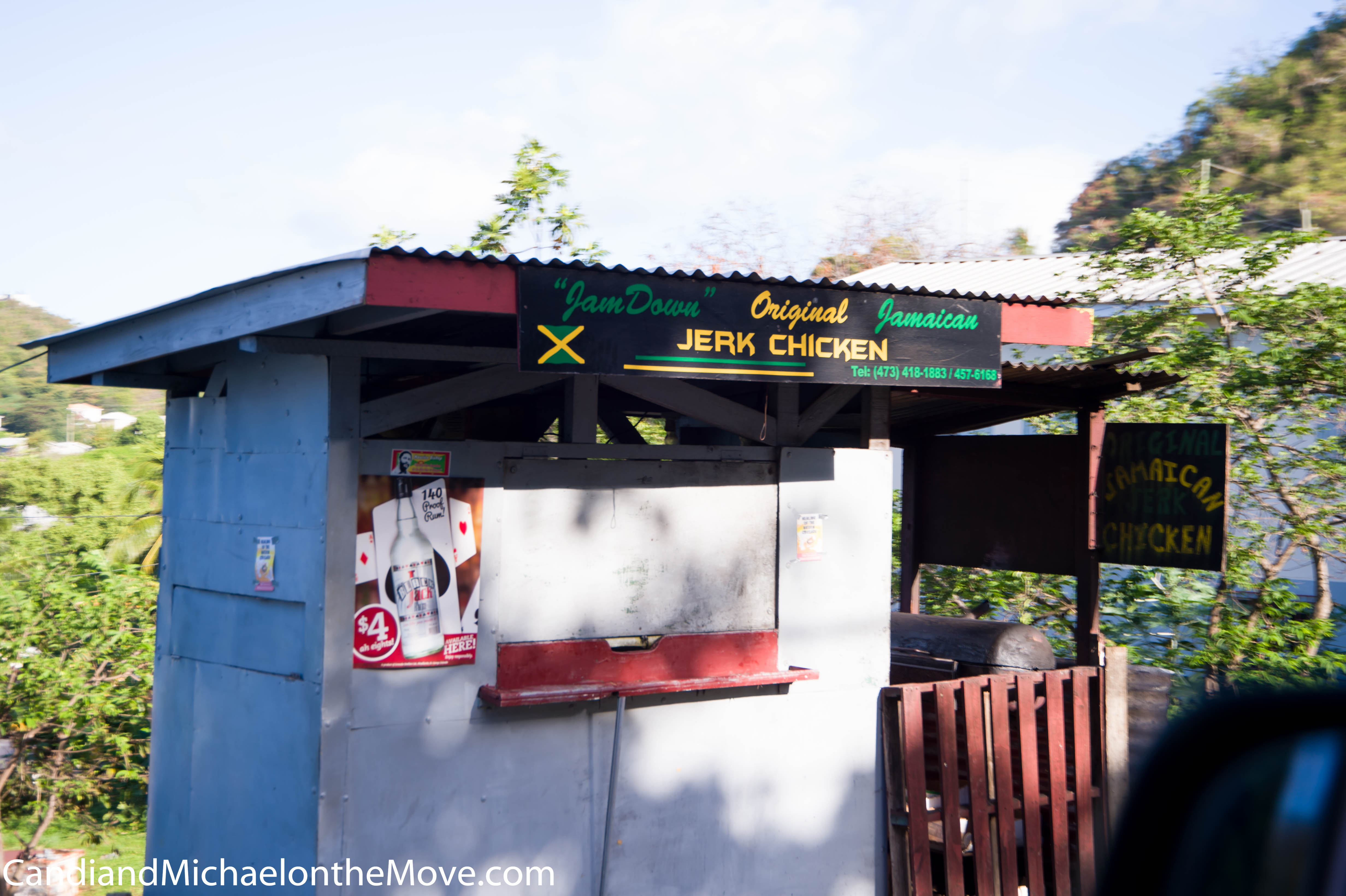
The Jamaican Jerk Chicken man is no exception and is well-known for his fabulous barbecue so people are pulling over, lining up, and now the road is barely one lane wide with traffic backed up in both directions.  If someone is slow to start up, everyone in the opposite direction guns their engines and starts a short convoy, nose to tail, trying to weave through the congestion.  Inevitably, a person or animal bolts out into traffic, cars stop, and then the folks waiting impatiently in the other direction careen through the small gap that has opened up.  This can happen five or six times in a short distance.  And if someone has called in a dinner order, they may stop right in the active road while someone runs their order out to the waiting car.  I’m sure the Jamaican Jerk man has somehow planned this – you have to stop, you get a brief moment to catch your breath and then smell his wonderful chicken.  Hmmmm, is there room to pull over and stop?

This is the Jamaican Jerk Chicken stand when  it is closed.  There is no way to take a picture, and live, when he is open.  It's that crazy.
This is the Jamaican Jerk Chicken stand when it is closed. There is no way to take a picture, and live, when he is open. It’s that crazy.

After maneuvering through this portion of the road, I get prepared for trucks.  Really big trucks, road hog trucks who know they own the road and take advantage of it.  I’m talking about full size cement mixers and huge construction trucks that make you wonder how they navigate the road at all, let alone when someone else is on the road – and with cars parked on both sides of the road, never directly across from each other because the road isn’t wide enough – but, of course, never all on one side because then where would the fun be?

This is a medium sized truck with a "reasonable" number of people in it.  And most are sitting down for a change.
This is a medium sized truck with a “reasonable” number of people in it. And most are sitting down – for a change.

The best you can hope for is to see one of these monsters on a straightway.  Yes, this means they will coming directly at you – fast and partially on your side – but at least you see them and can choose where you’re going to run yourself off the road so you can live for another day.  Next best thing is they might have a lead vehicle that is waving a large red flag letting you know a huge truck is following right behind or the big truck has the courtesy to be beeping as they round the curve – both clear signs to get out of the way, now, however you can.  Worst case is that the truck is by itself, the driver wants to get home, he is driving like a wild man and you round a curve with him coming right at your windshield, on your side of the road because these trucks don’t corner well and you pray as you swerve out of the way, hoping not to hit anyone or anything during your evasive driving tactics.  After passing, you don’t even have time to take a breath before the next obstacle presents itself.  It’s kind of like a fast paced video game except you don’t get a second life.  Drinks, anyone?

It astonishes me that I now feel “comfortable” driving in this madness.   Comfortable is not the right word really.  I’m always super alert, cautious, while trying to drive fast at the same time so people don’t pass me (by swerving into the other lane and essentially playing chicken).  Will they get by before the next curve?  Even with me braking to give them more room, will they pass before the car barreling towards us hits them and/or me?  You know, the one with the bus hugging its back bumper, trying to decide if he can pull out and pass at the same time.  I think I’m now at the point where I’m an “average” driver – definitely no longer the slowest, absolutely not the fastest, but holding my own.

When we first came to Grenada about 25 years ago, Michel drove and I was the navigator.  My job was to remind him to keep to the left side of the road and point out which way to drive around the roundabouts, as well as read the map and try to interpret the squiggly lines to determine which road was the “main” road and which road was the “secondary” road when everything looks like a secondary road.  After time, you kind of memorize the paths through and in your mind you see yourself going left around the roundabout before you get there.  It’s also helpful that other vehicles are driving in the correct direction and you go with the flow.

After a few trips, it made sense for me to start driving.  We started in a remote area with no traffic – a perfect place to begin to think about shifting with my left hand (no automatic jeeps in those days), signaling using my right hand (your automatic reaction is to signal by depressing the left lever and thus turning on the windshield wipers – again) and, most important, staying left.  We approached a small roundabout – no cars anywhere – and I made it to the correct road on the other side.  Michael smiled and said “Good job.  Next time drive around the other way.”  Yikes, with no context from other cars, I drove right, instead of left, around the roundabout.  It could only get better, right?

(Next up, Driving in Grenada – Part 2.)

Note: Special thanks to Michael for being willing to stand in the roundabout early one morning to take photos and then trying to capture more road pictures by shooting through the front windshield while I was driving.  I’d never ask him to do it on a Friday evening unless I was psyched to collect insurance money.  This was definitely above and beyond the call of duty!

Filed Under: Grenada, Travel Tagged With: driving, Grenada, travel

  • Page 1
  • Page 2
  • Page 3
  • Interim pages omitted …
  • Page 8
  • Go to Next Page »

Primary Sidebar

About Candi and Michael

Michael and I retired early in 2014. We stored everything we couldn't part with (art and prized possessions), sold most everything else, packed a trailer and started traveling full time. We rented a fully furnished house, in a place we always wanted to visit, lived there for 3 months and then we moved onto the next place. We stayed in Grenada for 3 months and ended up buying a house. Now we are modifying the plan a bit and we will live in Grenada and travel part-time. Read More…

Where are we now?

We are both in our home in Grenada.


Recent Posts

  • SpiceMas 2022 ~ “D Return” August 25, 2022
  • Shipping Barrels and Extreme Friendship ~ COVID-19 in Grenada December 16, 2020
  • Trying to Patch our Virus Free Bubble ~ COVID-19 in Grenada November 22, 2020
  • Reunited ~ And It Feels So Good! ~COVID-19 in Grenada July 13, 2020
  • The Corona Tango ~ One Step Forward, Two Steps Back ~ COVID-19 in Grenada June 27, 2020
  • Running in Circles, Nowhere to Go ~ COVID-19 in Grenada June 24, 2020
  • Holding Down the Fort, Part 2 ~ Rescue and Recovery/Order Restored ~ COVID-19 in Grenada June 18, 2020
  • Holding Down the Fort, Part 1 ~ Havoc Reigns ~ COVID-19 in Grenada June 14, 2020
  • Sounds of Silence ~ COVID-19 in Grenada April 12, 2020
  • COVID-19 in Grenada April 6, 2020
  • Small Country ~ Big Sadness February 28, 2020
  • Planting Seeds and Creating Sparks ~ Art and Love in Grenada May 22, 2019
  • Down to The Wire ~ Finishing (?) the Patio March 25, 2019
  • Pouring a Patio Extension ~ How Hard Can It Be? March 8, 2019
  • A Day in the Life ~ Picking up Sheila’s Birthday Cake April 9, 2018
  • I’m Famous! ~ (Almost) March 29, 2018
  • A Lesson in Patience ~ The Refrigerator Saga December 11, 2017
  • Taking the Plunge ~ The 2017 Ultimate Travel Writer’s Workshop October 25, 2017
  • Coming Home ~ Sweet, Sweet Home ~ First Impressions March 6, 2017
  • One Roof On, Another Roof Off ~ And Other Changes March 11, 2016
  • The Best of Grenada Sailing Week ~ The Workboat Regatta February 26, 2016
  • Two Steps Forward, No Steps Back ~ Making Progress February 23, 2016
  • Walking the Plank ~ to Dinner February 4, 2016
  • Taking the Inside-Out Concept to the Extreme – No Roof ( … for now ….) February 1, 2016
  • And So It Begins ~ Raising the Roof, Literally! January 26, 2016
  • The Calm Before the Storm ~ Christmas Season in Grenada January 15, 2016
  • Free at Last ~ Clearing our Container through Customs December 26, 2015
  • Best Laid Plans ~ and Murphy’s Law December 16, 2015
  • A Moving Adventure ~ “Bon Voyage”, Container December 14, 2015
  • Research, Procure, Pack, Repeat ~ Buying (everything) for our Grenada home December 5, 2015
  • Coming Home ~ Our First Visit to Our New House December 2, 2015
  • The Ultimate Challenge ~ Remote Project Management in a Third World Country November 29, 2015
  • Living the Dream ~ Buying a house in Grenada September 24, 2015
  • Proceed at Your Own Risk ~ Driving in Grenada (Part 3 of 3) April 16, 2015
  • Proceed at Your Own Risk ~ Driving in Grenada (Part 2 of 3) March 31, 2015
  • Proceed at Your Own Risk ~ Driving in Grenada (Part 1of 3) March 29, 2015
  • Canboulay, J’ouvert, Mas ~ Carriacou Carnival 2015 March 27, 2015
  • “Eat Local” ~ John’s Oceanview Restaurant February 11, 2015
  • Gourmet Grenadian ~ Boots Cuisine February 5, 2015
  • Our First Adventure ~ Welcome to Grenada January 29, 2015
  • Making Home ~ Settling into our Villa in Woburn, Grenada January 27, 2015
  • Canine Captain ~ Mick’s Travel Adventure January 23, 2015
  • Operation Grenada ~ Moving Ourselves to the West Indies January 21, 2015
  • Imagination Revealed ~ Dale Chihuly’s Glass Inspirations December 31, 2014
  • Delectable Ritual ~ Savouring the Sunset December 21, 2014
  • Dinner on a Sandbar ~ Blue Moon Beach Grill November 26, 2014
  • Best Beach Getaway ~ Ocracoke Island November 10, 2014
  • Whirlwind Tour ~ Showcasing the Essence of the Outer Banks November 5, 2014
  • Wild Mustangs ~ An Outer Banks Adventure October 18, 2014
  • Marvelous Moondance ~ Full Lunar Eclipse October 15, 2014
  • An Unexpected Gourmet Delight ~ Mike Dianna’s Grillroom October 12, 2014
  • Personal Chef on Call ~ Chez Michael October 8, 2014
  • An Enchanted Sanctuary ~ Elizabethan Gardens October 5, 2014
  • Fun Music and good food too! ~ Cravings September 30, 2014
  • Chasing the Light ~ Shooting the Bodie Lighthouse at Daybreak September 23, 2014
  • Learning to Fly ~ The Wright Brothers in Kitty Hawk September 10, 2014
  • Creating Home, Again ~ Arriving in the Outer Banks September 5, 2014
  • Farewell Key West ~ C & M “On the Move” August 25, 2014
  • Beautiful Birthday Memories ~ Dinner at Cafe Marquesa August 4, 2014
  • “A Key West Locals Secret” ~ New York Pasta Garden July 29, 2014
  • The Square Grouper ~ And Other Fish Tails July 26, 2014
  • The Locals Hideaway ~ Boca Chica Beach July 24, 2014
  • Tantalizing Tapas ~ Santiago’s Bodega July 21, 2014
  • Doesn’t Get Any Better Than This ~ Moonrise/Sunset Sailing July 18, 2014
  • Happy Wife, Happy Life ~ The Key West Jewelry Bar July 8, 2014
  • ‘Hunker Down’ with Bill Blue and Friends July 3, 2014
  • Local Color ~ Mr. James Chapman July 1, 2014
  • A Mid Summer’s Night Dream & Spectacle ~ Summer Solstice June 25, 2014
  • Savory or Sweet? ~ Key Plaza Creperie June 19, 2014
  • “A Great Place …. if You Can Find It” ~ Hogfish Bar and Grill June 19, 2014
  • ONE HUMAN FAMILY and the Key West Pride Parade June 18, 2014
  • Cajan Delights at the Blossom Cafe June 14, 2014
  • Candi and Michael’s Honey Moon June 14, 2014
  • Hunting for Iguanas June 4, 2014
  • Rainy Day and Café Solé June 2, 2014
  • Exploring Key West May 27, 2014
  • Really settling in May 25, 2014
  • Market Day Delights May 22, 2014
  • Namaste ~ Our Key West home May 17, 2014
  • Arriving in our Key West Paradise May 16, 2014

Tag Cloud

Art Blue Moon Beach Grill Boots Cuisine Carnival Carriacou Carnival Christmas construction Container COVID-19 Dale Chiuhly driving expat life Grenada Grenada Sailing Festival Hurricane Ivan Iguana Inn on Silver Lake Jessica's Dune Key West Mick Mount Moritz Moving Mural museum music Namaste nature Outer Banks Preparation Rebecca-art-studio rennovation renovations Restaurants RoxiArtwork sailing Sarasota Area SpiceMas storage sunsets The Arches travel travel preparation Travel Writing TSA precheck Welcome Villa

Copyright © 2026 · Lifestyle Pro on Genesis Framework · WordPress · Log in

Manage Cookie Consent
To provide the best experiences, we use technologies like cookies to store and/or access device information. Consenting to these technologies will allow us to process data such as browsing behavior or unique IDs on this site. Not consenting or withdrawing consent, may adversely affect certain features and functions.
Functional Always active
The technical storage or access is strictly necessary for the legitimate purpose of enabling the use of a specific service explicitly requested by the subscriber or user, or for the sole purpose of carrying out the transmission of a communication over an electronic communications network.
Preferences
The technical storage or access is necessary for the legitimate purpose of storing preferences that are not requested by the subscriber or user.
Statistics
The technical storage or access that is used exclusively for statistical purposes. The technical storage or access that is used exclusively for anonymous statistical purposes. Without a subpoena, voluntary compliance on the part of your Internet Service Provider, or additional records from a third party, information stored or retrieved for this purpose alone cannot usually be used to identify you.
Marketing
The technical storage or access is required to create user profiles to send advertising, or to track the user on a website or across several websites for similar marketing purposes.
  • Manage options
  • Manage services
  • Manage {vendor_count} vendors
  • Read more about these purposes
View preferences
  • {title}
  • {title}
  • {title}